
Advertorial or Sponsorship User published Content does not represent the views of the Company or any individual associated with the Company, and we do not control this Content. In no event shall you represent or suggest, directly or indirectly, the Company's endorsement of user published Content.
The company does not vouch for the accuracy or credibility of any user published Content on our Website and does not take any responsibility or assume any liability for any actions you may take as a result of reading user published Content on our Website.
Through your use of the Website and Services, you may be exposed to Content that you may find offensive, objectionable, harmful, inaccurate, or deceptive.
By using our Website, you assume all associated risks.This Website contains hyperlinks to other websites controlled by third parties. These links are provided solely as a convenience to you and do not imply endorsement by the Company of, or any affiliation with, or endorsement by, the owner of the linked website.
Company is not responsible for the contents or use of any linked website, or any consequence of making the link.
Rocket Money Reviews and Ratings (2026): Is It Worth It?

Official Rocket Money logo
TL;DR: Summary
- Rocket Money aims to help users budget their spending, cancel subscriptions, and track bills by syncing it to their financial accounts.
- The free version offers basic tools, and there is a flexible premium plan, but a few users note problems with billing and slow support.
- Reviews are mixed: high marks in app stores, but lower scores on the Trustpilot and Better Business Bureau (BBB) sites because of complaints about surprise charges and data privacy.
- The bill negotiation tool claims big savings, but some users question the fees and whether the savings were real or worth it.
- It’s best for people who want an easier way to stay on top of money; not ideal for those who prefer full control or don’t want to link their accounts.
Millions of Americans are still feeling the pressure of stagnant wages and rising expenses. According to Fortune, the country’s economic well-being has been declining for years, and the idea of affordability is being redefined.
In that context, interest in personal finance apps has climbed. People want more control over subscriptions, bills, and spending habits. That’s why many are searching for Rocket Money reviews. But what does Rocket Money actually do, and how useful is it for day-to-day budgeting?




What is Rocket Money?
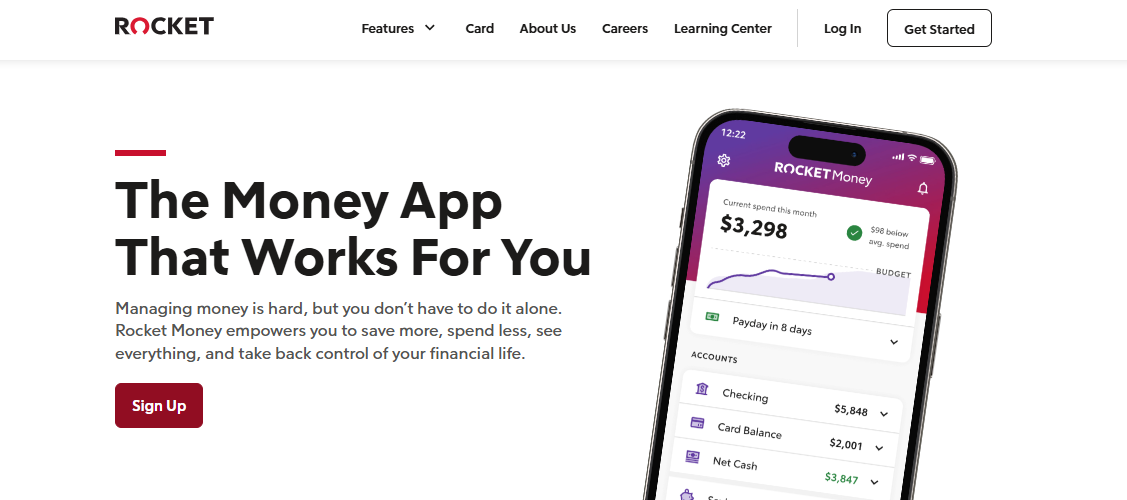
Rocket Money website homepage
Rocket Money is a personal finance management app built to help users track spending, cancel subscriptions, and stay on top of bills. It connects to users’ bank accounts, credit cards, and other financial accounts.
Formerly known as Truebill, Rocket Money rebranded in August 2022 to align more closely with its parent company, Rocket Companies.
Company overview
- Founded: 2015
- Type of entity: Corporation
- Alternate names: Truebill, Truebill Corp, Truebill, Inc
- Current name: Rocket Money
- Headquarters: Silver Spring, Maryland
- Product type: Personal finance management app
- Parent company: Rocket Companies
- Services offered through: Rocket Money app only (no in-person locations)
Key services or programs
- Manage Subscriptions: Tracks recurring charges and lets users cancel subscriptions directly through the app. Useful for spotting unwanted subscriptions.
- Spending Insights: Breaks down spending categories to help users understand and adjust their spending habits.
- Bill Negotiation: The bill negotiation service connects users with the Rocket Money team, who attempt to lower existing bills on the user’s behalf.
- Net Worth: Calculates real-time net worth using synced bank accounts, investment accounts, and debts.
- Financial Goals: Users can set money goals, monitor progress, and automate transfers using tools like the smart savings account.
- Credit Scores: Displays credit score data to give a snapshot of current financial health.
- Budgeting: Allows users to create unlimited budgets, categorize expenses, and compare activity across months.
- Widgets: Offers at-a-glance tracking for budgets, spending, and financial goals without opening the Rocket Money app.
Pricing and fees
- Free version: The free version includes basic budgeting tools and subscription management.
- Premium membership
- Includes access to premium features like unlimited budgets, net worth tracking, and smart savings tools.
- Starts with a seven-day free trial. After that, users pick their own monthly price from a sliding scale.
- Also uses a “pay what you think is fair” model between $7-14 per month (subject to change).
- Bill negotiation: If Rocket Money lowers a bill, it takes 35 to 60 percent of the first year’s savings as a fee. Users choose the rate. No charge if the service doesn’t save anything.
Eligibility and requirements
- Must be at least 18 years old
- Valid email address required to create an account
- Must link a bank account or other financial accounts to access features like budgeting, subscription management, and spending insights
How to use
- Sign up: Create an account through the Rocket Money app or website.
- Set your goals: Answer a few quick questions about your financial goals and what you’re looking to manage.
- Link accounts: Connect your bank account and other financial accounts so the app can start tracking.
- Get insights: Rocket Money scans for subscriptions, spending patterns, and ways to save money.
- Use the tools: Access features like budgeting, smart savings, and subscription cancellation right from the app.
When linking your bank account, Rocket Money uses Plaid, a secure third-party service, to access your transaction history and account balances.
Rocket Money pros and cons
Here’s what the Rocket Money app gets right and where it might not work for everyone.
Pros
- Connects all bank accounts, cards, and investments in one view
- Easy to set up and adjust monthly budgets
- Offers bill negotiation to lower bills automatically
- Includes a free plan for basic budgeting and tracking
Cons
- The free version feels limited without upgrades
- Support isn’t always quick or available when needed
- Doesn’t offer tools for paying down debt
- Tracks investments but doesn’t help plan them
- Budgeting is simple; no advanced methods like zero-based budgeting
- Bill negotiation fees can be high if users don’t self-negotiate
Your Best Lending Partner: We match you with top lenders for the best deals. Fast, Easy Process: Quick approvals with expert support. Tailored Solutions: Flexible terms that fit your needs.

Rocket Money reviews, ratings & complaints
Here’s what people are saying about the Rocket Money app: the good, the bad, and what to expect.
Better Business Bureau (BBB) reviews
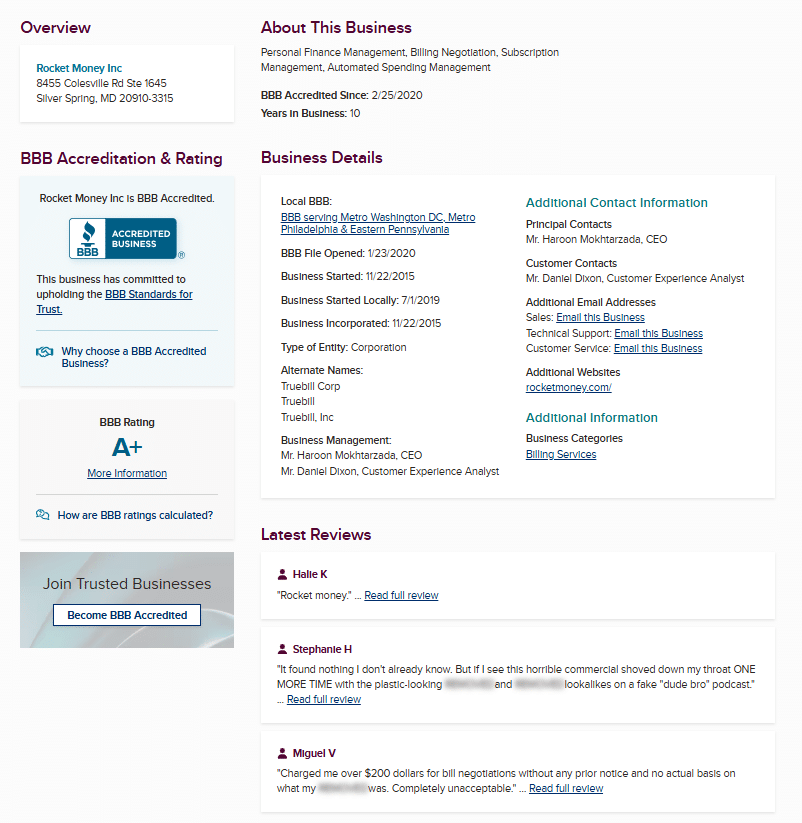
Rocket Money’s Better Business Bureau profile
Rocket Money has an A+ BBB rating, but most user reviews are negative, averaging 1.89 stars.
Common complaints include surprise charges over $100, poor support, and trouble canceling accounts. Some users said the bill negotiation service made changes they didn’t agree to, then charged a fee. Others had issues unlinking bank accounts or getting help when problems came up.
There have been 259 complaints in the past three years, with 95 closed in the last 12 months. Refunds were issued in some cases, but usually after delays.
Trustpilot reviews

Rocket Money Trustpilot profile
Rocket Money has a 3.5-star rating on Trustpilot, based on over 4,100 reviews.
Some users found it helpful for tracking subscriptions and managing budgets. A few mentioned support reps who helped resolve billing or access issues.
But many complained about surprise charges, hard-to-cancel premium subscriptions, and savings claims that didn’t match results. Others reported trouble accessing accounts or questioned how Rocket Money handled their data.
Reddit reviews
Reddit users are mixed on Rocket Money. Some like it for spotting missed subscriptions and viewing all bank accounts in one place. Others say the budgeting feels basic and not worth paying for.
There’s also hesitation around linking financial accounts, with a few users unsure how the app handles data on the free plan. While some find the bill negotiation service useful, others feel the savings were overstated or unclear.
Google and Apple reviews

Rocket Money app ratings
The Rocket Money app gets solid ratings: 4.6 on Google Play and 4.5 on the App Store.
Many say it helps with tracking subscriptions, organizing spending, and spotting billing issues. Others felt the premium membership was worth the cost.

Rocket Money app reviews
Some users were less impressed, pointing to missed transactions or limited budgeting features. A few questioned the value of the bill negotiation service, but overall, most found it useful for staying organized.

Outcomes and success rates
Rocket Money says it’s helped users save over $245 million, with an 85 percent success rate on bill negotiations.
Some users back that up, saying the service lowered their bills and saved time. Others weren’t as happy because of small or unclear savings, or being charged after changes they didn’t agree to. A few questioned how the app calculates savings, especially when it involves service downgrades.
Who is Rocket Money for?
Here’s what to know about who Rocket Money is a good fit for and who might want something else.
Best for
- People juggling multiple accounts or subscriptions who want everything in one view
- Anyone who wants alerts for recurring charges they might miss
- Users willing to pay for convenience, especially to avoid manual tracking or bill calls
Not recommended for
- Those who already manage money with spreadsheets or bank tools
- Anyone uncomfortable sharing financial data with third-party apps
- People focused on cutting expenses who don’t want another monthly rocket money cost
Rocket Money alternatives to consider
Here are some alternatives to Rocket Money that may better fit different budgeting styles or financial priorities.
Monarch Money
Monarch Money focuses on visual breakdowns of monthly spending and supports zero-based budgeting. It’s a better option for users who want structured planning and more detailed charts than what Rocket Money’s features provide.
YNAB
YNAB is built for full control. It offers deep customization, manual entry, and works well for shared accounts. It’s a strong fit for those who want to be hands-on with every part of their budget.
Simplifi
Simplifi provides detailed financial summaries, including reports on income, spending, savings, and refunds. It’s designed for users who want clean data visuals and more structured tracking than most budgeting apps offer.
EveryDollar
EveryDollar follows a zero-based budgeting method. The free version requires manual input, while the Premium plan adds automation but costs more than some competitors with advanced tools.
Credit Karma
Credit Karma centers on credit score tracking but now includes features like net worth monitoring and transaction imports. It remains free and useful for users focused on credit and basic financial management.
Final verdict
Rocket Money is a good fit for people who want a hands-off way to stay on top of spending and bills. The paid features add convenience, but the Rocket Money cost won’t make sense for everyone. Starting with the free version is the easiest way to see if it works for how someone handles their money.
Frequently asked questions
Is Rocket Money legit?
Yes. Rocket Money, formerly Truebill, is a registered company and is widely used. It’s backed by Rocket Companies, the same parent company behind Rocket Mortgage.
Can Rocket Money be trusted?
Rocket Money offers FDIC-insured savings through its partner banks, real-time credit alerts, and up to $1 million in identity theft protection. Still, some concerns have been raised about how the app handles all your financial information. While many users find Rocket Money safe, trust may depend on how someone prioritizes privacy in their financial life.
Is it hard to cancel Rocket Money?
Canceling through the site is straightforward. Just select the subscription, choose “Cancel this for me,” and submit the request. From there, the support team handles the rest. The process works directly through Rocket Money’s mobile app or website.
Why did Rocket Money charge me $48?
This likely came from the bill negotiation tool. For example, if Rocket Money saves $120 a year and you agreed to a 40 percent fee, that would equal a $48 charge. The app applies this to the card you authorized when you submitted the request.
What is the Rocket Money scandal?
A complaint filed with the CFPB accused Rocket Money of using a misleading design and violating data privacy laws. The complaint claims the app promoted strong privacy while disclosing that it shared data with third parties.
It also alleges inflated savings estimates and misuse of credit reports for marketing, potentially violating the Fair Credit Reporting Act. These allegations haven’t led to formal penalties but raise questions for those concerned about how Rocket Money offers and promotes its valuable services.


Sponsored Advertising Content:
Advertorial or Sponsorship User published Content does not represent the views of the Company or any individual associated with the Company, and we do not control this Content. In no event shall you represent or suggest, directly or indirectly, the Company's endorsement of user published Content.
The company does not vouch for the accuracy or credibility of any user published Content on our Website and does not take any responsibility or assume any liability for any actions you may take as a result of reading user published Content on our Website.
Through your use of the Website and Services, you may be exposed to Content that you may find offensive, objectionable, harmful, inaccurate, or deceptive.
By using our Website, you assume all associated risks.This Website contains hyperlinks to other websites controlled by third parties. These links are provided solely as a convenience to you and do not imply endorsement by the Company of, or any affiliation with, or endorsement by, the owner of the linked website.
Company is not responsible for the contents or use of any linked website, or any consequence of making the link.
This content is provided by New Start Advantage LLC through a licensed media partnership with Inquirer.net. Inquirer.net does not endorse or verify partner content. All information is for educational purposes only and does not constitute financial advice. Offers and terms may change without notice.


