
Advertorial or Sponsorship User published Content does not represent the views of the Company or any individual associated with the Company, and we do not control this Content. In no event shall you represent or suggest, directly or indirectly, the Company's endorsement of user published Content.
The company does not vouch for the accuracy or credibility of any user published Content on our Website and does not take any responsibility or assume any liability for any actions you may take as a result of reading user published Content on our Website.
Through your use of the Website and Services, you may be exposed to Content that you may find offensive, objectionable, harmful, inaccurate, or deceptive.
By using our Website, you assume all associated risks.This Website contains hyperlinks to other websites controlled by third parties. These links are provided solely as a convenience to you and do not imply endorsement by the Company of, or any affiliation with, or endorsement by, the owner of the linked website.
Company is not responsible for the contents or use of any linked website, or any consequence of making the link.
Sallie Mae Reviews and Ratings

Sallie Parent Company Logo
Federal student loans do not always cover the full cost of attendance. When the gap remains, private lenders become part of the conversation. Sallie Mae reviews appear in nearly every search result for students and families weighing their options.
Sallie Mae is the largest private student loan lender in the United States. The company holds a 57 percent market share of private student loan originations. It has generated more than $7 billion each year and served over one million students since 1972.
In 2026, Sallie Mae products now operate under a new parent company brand called Sallie. The student loan and savings products continue unchanged.
This review covers loan types, current rates, and repayment options. It also addresses the hard credit pull, the lack of refinancing, the Navient split, the complaint record, and who Sallie Mae works for.
One thing is clear before going further. Students should exhaust all federal loan options before considering any private lender, including Sallie Mae.
Evaluate these top-rated lenders to find a better match for your credit tier:




- Direct Lending Excellence: Matches you with the best loans.
- Loans ranging from $2,500 to $100,000
- Flexible terms: 3 to 120 months, 24 hours post-approval
- Same day approval



- Direct Lending Excellence: Matches you with the best loans with optimal loan terms.
- Comprehensive Loan Network: Loans ranging from $2,500 to $50,000
- Flexibility & Speed: Flexible terms from 3 to 120 months, 24 hours post-approval.

- Loan amounts up to $100,000
- Custom Terms: Repayment periods from 12 to 60 months with fast 48-hour approvals.
- Trusted Expertise: Recognized for ethical lending and innovative financial solutions.
What is Sallie Mae?

Sallie Mae Official Website Header
Sallie Mae Bank is a publicly traded consumer bank. It is the largest private student loan lender in the U.S.
The company was founded in 1972 as the Student Loan Marketing Association. It started as a government-backed agency that handled federal student loans. It went fully private in 2004. Today, Sallie Mae has no connection to federal student loans. It only originates private loans.
All loans are made by Sallie Mae Bank. The bank is regulated by the Utah Department of Financial Institutions, the FDIC, and the Consumer Financial Protection Bureau (CFPB). It also offers FDIC-insured deposit products.
In 2014, Sallie Mae split into two separate companies. Sallie Mae Bank kept the private student loan and savings business. Navient took over federal student loan servicing as a standalone entity. These are now independent companies with no shared operations.
In 2026, Sallie Mae Bank began operating under a new parent brand called Sallie. The student loan and savings products continue under the Sallie Mae name.
The company holds a 57 percent market share of private student loan originations. It generates more than $7 billion annually and serves students in all 50 states, Puerto Rico, and the U.S. Virgin Islands. It holds an A-plus rating from the Better Business Bureau (BBB).
Is Sallie Mae the same as Navient?
No. Sallie Mae and Navient are separate, independent companies.
Before 2014, Navient was part of Sallie Mae and handled federal student loan servicing. That year, the company split. Navient took the federal loan servicing portfolio and became its own entity.
Sallie Mae Bank retained the private student loan origination business.
Navient has faced multiple CFPB enforcement actions and lawsuits over its handling of federal student loan borrowers. Those actions do not involve Sallie Mae Bank or its private loan products. Borrowers with Sallie Mae private loans are serviced by Sallie Mae, not Navient.
What is Sallie, and how does it relate to Sallie Mae?
Sallie is the new parent company brand launched in 2026. It encompasses Sallie Mae student loans and savings products alongside new tools for students. These tools include college search, scholarship matching, and financial planning resources.
Sallie Mae products continue under the Sallie Mae name. Undergraduate loans, graduate loans, career training loans, and savings accounts are not changing. The rebranding does not affect existing borrowers.
Sallie Mae loan types
Sallie Mae offers more loan types than most private student lenders. This is a genuine differentiator for borrowers in non-standard programs.
- Undergraduate loans are for students earning a bachelor’s or associate’s degree at participating schools. They are available to full-time, half-time, and less-than-half-time students.
- Graduate loans cover most disciplines. Sallie Mae has separate products for MBA and health professions graduate programs.
- Career training loans serve students in professional training, certificate, and trade school programs. Very few private lenders offer this option.
- Bar exam loans help law school graduates prepare for the bar exam.
- Medical residency loans support physicians completing residency or fellowship training.
- K-12 loans finance private school tuition.
- Study abroad funding is available as part of a participating school’s program.
Loans can cover up to 100 percent of school-certified annual costs minus financial aid. This includes tuition, fees, books, room and board, supplies, laptops, and transportation. The minimum loan amount is $1,000.
How Sallie Mae works, step by step
- Exhaust all federal loan options first. Submit the FAFSA and accept all available federal aid before applying for a private loan.
- Determine how much additional funding is needed beyond federal loans and institutional aid.
- Visit salliemae.com and begin the application. Sallie Mae requires a hard credit inquiry at this step. There is no soft-pull prequalification available to see a rate before applying.
- Provide personal information, school enrollment details, and the loan amount requested. A cosigner can be added to strengthen the application.
- Sallie Mae conducts a hard credit inquiry on the applicant and cosigner. This will temporarily affect both credit scores.
- Receive a loan decision and rate offer. The approval rate is about 95 percent when a cosigner is included.
- Review the loan terms carefully. Confirm the APR, loan term, repayment option, and any cosigner obligations before signing.
- The school certifies the loan amount. Funds are disbursed directly to the school.
- Repayment begins based on the repayment option chosen at application.
The hard credit pull: what it means before applying
Unlike most major private student loan lenders, Sallie Mae does not offer soft-pull prequalification. College Ave, Earnest, and Discover all allow borrowers to check rates without a hard inquiry. Sallie Mae does not.
Borrowers cannot check their rate or see if they qualify without submitting a full application. Each application triggers a hard credit inquiry on both the borrower and the cosigner.
A hard inquiry temporarily lowers credit scores. The effect is typically a few points and lasts about 12 months.
For borrowers applying to multiple lenders, each Sallie Mae application triggers a separate hard pull. This is the most common criticism of the lender. It puts borrowers at a disadvantage compared to lenders that allow rate shopping without a credit impact.
Sallie Mae rates, fees and eligibility
Undergraduate loans
- Fixed APR from 2.89 percent to 17.49 percent, including 0.25 percent autopay discount
- Variable APR from 3.75 percent to 16.37 percent, including 0.25 percent autopay discount
- Variable rates tied to the 30-day Average Secured Overnight Financing Rate (SOFR)
Graduate loans
- Fixed APR from 2.89 percent to 14.99 percent
- Variable APR from 3.75 percent to 14.48 percent
Career training loans
- Fixed APR from 2.89 percent to 17.64 percent
- Variable APR from 3.75 percent to 16.62 percent
Fees
- No application fee
- No origination fee
- No prepayment penalty
- Late fee is 5 percent of the past due amount, maximum $25, after a 15-day grace period
- Returned check fee is up to $20
- Autopay discount is a 0.25 percentage point rate reduction for enrollment in automatic payments
Eligibility
- U.S. citizen or permanent resident. International and DACA students are eligible with a creditworthy U.S. citizen or permanent resident cosigner.
- Minimum credit score is in the mid-600s per NerdWallet. Sallie Mae does not disclose a public minimum.
- Minimum income is not disclosed.
- Enrollment can be full-time, half-time, or less than half-time at a participating school.
- A cosigner is not required. However, 91 percent of undergraduate loans are cosigned. Students are four times more likely to be approved with one.
Sallie Mae repayment options
Sallie Mae offers more in-school repayment flexibility than most private lenders. The choice made at application affects the total loan cost.
- Deferred repayment requires no payments while in school or during the six-month grace period after graduation. Unpaid interest capitalizes at the end of the grace period. It is added to the principal balance, increasing the total amount owed. This option has the lowest in-school burden but the highest total cost.
- Fixed repayment requires a $25 flat monthly payment while in school and during the grace period. Full principal and interest payments begin after. This reduces interest capitalization without requiring full interest payments.
- Interest-only repayment requires paying only the interest accruing each month while in school and during the grace period. This prevents the balance from growing. Sallie Mae offers a lower APR for this option. It has the highest in-school payment but the lowest total cost.
- Graduated repayment begins with interest-only payments for 12 months after the grace period ends. It then transitions to full principal and interest payments. This option is available for borrowers who need a ramp-up period after graduation.
Deferred repayment results in the highest total cost due to interest capitalization. Borrowers should understand this tradeoff before choosing.
Sallie Mae cosigner release, how it works and who qualifies
Sallie Mae offers cosigner release after 12 consecutive on-time principal and interest payments following the in-school and grace periods. This is among the shortest release timelines in the private student loan market. Many competitors require 24 to 36 months.
To qualify for cosigner release, the primary borrower must meet the following conditions.
- The borrower must have graduated.
- The borrower must have made 12 on-time full principal and interest payments.
- The borrower must meet Sallie Mae’s credit requirements at the time of the release request.
- The borrower must have no current delinquencies.
Sallie Mae provides quarterly FICO score updates to both borrowers and cosigners. This helps cosigners track the impact on their credit over the life of the loan.
Cosigner release requires the borrower to be in full principal and interest repayment. Deferred or interest-only repayment periods do not count toward the 12-month requirement.
Sallie Mae customer reviews: what borrowers report
Sallie Mae receives strong marks for its application and onboarding experience. The pattern shifts in repayment and post-graduation servicing, where complaints are concentrated.
Trustpilot reviews

Sallie Mae Trustpilot profile
Sallie Mae’s own testimonials page features positive Net Promoter Score survey responses. These are sourced from Sallie Mae’s own customer surveys, not an independent review platform.
On independent platforms, borrowers describe the application process as clear and fast. Many praise the school coordination. Summer term coverage helps when federal aid runs out.
Borrowers considering Sallie Mae should check independent review platforms for the most current ratings and feedback before applying.
Better Business Bureau (BBB) reviews
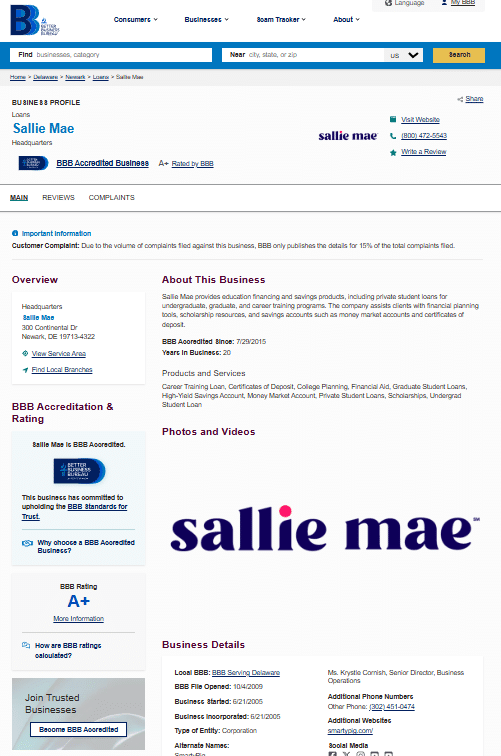
Sallie Mae Better Business Bureau profile
Sallie Mae holds an A-plus BBB rating and is BBB-accredited.
BBB complaints reflect two consistent patterns. The first is inaccurate credit bureau reporting. One 2026 complaint stands out. A cosigner saw a 69-point drop in their credit score. Four Sallie Mae representatives had confirmed that no delinquency would be reported. The second pattern involves document mix-ups during the application or verification process.
U.S. News notes that customer service reviews are “less than stellar.”
Sallie Mae responds to BBB complaints. Resolution consistency is mixed per documented complaint responses.
Sallie Mae CFPB complaints
The CFPB received 369 student-loan-related complaints about SLM Corp., Sallie Mae’s holding company, in 2024. This is one of the higher volumes among private student loan lenders.
The top complaint categories are dealing with the lender or servicer and struggling to repay the loan.
All but two complaints received timely responses. A total of 314 were closed with explanation, 47 with nonmonetary relief, and seven with monetary relief.
Borrowers submitted more than 1,000 total complaints over three years. Of those, 770 were student loan-related. This fits the scale of the lender but is still a meaningful volume next to competitors.
ConsumerAffairs reviews
ConsumerAffairs reviews surface strong negative sentiment in repayment. Borrowers describe immediate billing after graduation with no adjustment period. Borrowers also report rapid delinquency reporting and unhelpful customer service during hardship.
One ConsumerAffairs review describes a cosigner with an 800 credit score. That cosigner received an 18-plus percent rate quote on a $32,000 loan. The rate was higher than expected for that credit profile.
Reddit reviews
Reddit discussions in r/StudentLoans reflect a pattern. Borrowers warn about the hard credit pull and difficulty with cosigner release. Many recommend comparing College Ave or Earnest before choosing Sallie Mae.
Sallie Mae outcomes and success rate
Sallie Mae does not publish a single overall success rate or satisfaction benchmark. However, several data points provide a clear picture of borrower outcomes.
The approval rate is about 95 percent when a creditworthy cosigner is included. Students are four times more likely to be approved with a cosigner than without one. A total of 91 percent of undergraduate loans are cosigned.
Sallie Mae covers up to 100 percent of school-certified costs minus financial aid. This includes tuition, fees, room, board, books, and transportation. The minimum loan amount is $1,000.
Cosigner release is available after 12 consecutive on-time principal and interest payments. This is one of the shortest release timelines among major private student loan lenders. Many competitors require 24 to 36 months.
Sallie Mae provides quarterly free FICO score updates for both borrowers and cosigners. This allows both parties to track credit impact throughout the life of the loan.
Sallie Mae offers hardship forbearance and deferment for qualifying situations. These include internship, fellowship, and residency programs.
On the complaint side, the CFPB received 369 student-loan-related complaints about SLM Corp. in 2024. Borrowers submitted more than 1,000 total complaints over three years. All but two received timely responses from the company. A total of 314 were closed with explanation, 47 with nonmonetary relief, and seven with monetary relief.
These figures fit the scale of the largest private student loan lender in the country. They are still a meaningful volume next to competitors and worth weighing before applying.
Sallie Mae pros and cons
Pros
- Largest private student loan lender in the U.S., with a 57 percent market share and over $7 billion originated annually
- Broadest loan type coverage of any major private lender, including undergraduate, graduate, career training, bar exam, medical residency, K-12, and study abroad
- Available to part-time and less-than-half-time students, a population that most competitors do not serve
- No origination fee, no application fee, and no prepayment penalty
- Four in-school repayment options offering more flexibility than most competitors
- Cosigner release available after 12 months, a shorter timeline than many competitors
- Quarterly free FICO score updates for borrowers and cosigners
- 95 percent approval rate when a creditworthy cosigner is included
- Available in all 50 states, Puerto Rico, and the U.S. Virgin Islands
- Hardship forbearance and deferment are available for internship, fellowship, or residency programs
Cons
- No soft-pull prequalification available. A hard credit inquiry is required before seeing a rate, and it affects both borrower and cosigner credit scores.
- No student loan refinancing offered. Borrowers who want to refinance after graduation must go to a different lender.
- 369 CFPB complaints in 2024, one of the highest volumes among private student loan lenders
- Documented complaint pattern around payment hardship management, inconsistent customer service information, credit bureau reporting disputes, and difficulty removing cosigners
- Variable rates can increase over the life of the loan, a meaningful risk on loans with 10 to 15-year terms
- Minimum income and credit score requirements are not publicly disclosed, limiting the ability to assess odds of approval before applying
- ConsumerAffairs and BBB reviews reflect a pattern of borrowers feeling unsupported during repayment hardship
What Sallie Mae does not offer are two important limitations
No soft-pull prequalification
Sallie Mae does not allow borrowers to check their rate with a soft credit inquiry. Most major private lenders do. Every rate inquiry requires a full application and a hard credit pull. This affects both the borrower and cosigner. Borrowers who want to compare rates across lenders should complete the Sallie Mae application last. They can also use a marketplace like Credible to compare rates without a hard pull.
No student loan refinancing
Sallie Mae does not offer refinancing for its own loans or any other student loans. Borrowers who graduate and want to refinance to a lower rate must apply with a separate lender. Earnest, SoFi, and ELFI are commonly cited refinancing options. This matters most for borrowers who expect strong income growth after graduation. Those borrowers often qualify for lower rates through refinancing.
Federal loans vs. Sallie Mae, what to exhaust first
Federal student loans should always be the first option before any private loan. Sallie Mae itself states this on its website.
- Federal subsidized loans charge no interest while the student is in school. They offer income-driven repayment options, loan forgiveness programs, and deferment and forbearance protections. None of these applies to private loans.
- Federal unsubsidized loans are available regardless of financial need. Interest accrues in school, but repayment protections remain.
- Federal PLUS loans are available for graduate students and parents. The fixed rate is currently 8.05 percent for 2024-25. There is no origination fee alternative through Sallie Mae, but a private loan may be lower for creditworthy borrowers.
Private loans, including Sallie Mae loans, do not offer the income-driven repayment, forgiveness, deferment, or forbearance protections required of federal loans.
Sallie Mae’s rate is only lower than federal PLUS when the borrower or cosigner has strong credit. Borrowers should compare the offered APR against the current PLUS rate before signing.
Is Sallie Mae legit?
Yes. Sallie Mae Bank is a federally regulated, FDIC-insured consumer bank with more than 50 years of operating history. It holds an A-plus BBB rating and 57 percent market share of private student loan originations.
The 2014 split from Navient resolved the federal loan servicing controversy into a separate entity. Sallie Mae Bank’s private loan operations have not faced the same CFPB enforcement actions as Navient.
The 369 CFPB complaints in 2024 are a notable volume. It reflects real borrower frustration with repayment and servicing. It aligns with Sallie Mae’s scale, but worth noting before applying.
Legitimacy is not the concern. Servicing quality and repayment hardship support are where borrower experience varies most.
Who should use Sallie Mae?
Sallie Mae is the right fit for several specific borrower profiles.
- Students in career training, certificate programs, or trade schools who cannot find private loan options elsewhere. Sallie Mae’s career training loan is one of very few private options for this population.
- Less-than-half-time students who need private loan funding. Most competitors require at least half-time enrollment.
- Borrowers who need a cosigner and have access to a creditworthy one. The 95 percent approval rate with a cosigner and release available after 12 months makes this a strong option.
- Students at the federal PLUS loan boundary who can get a lower rate through Sallie Mae with a strong cosigner.
Sallie Mae is not the right fit in certain situations.
- Borrowers who want to compare rates across multiple lenders without a hard pull impact should use Credible or another marketplace first.
- Borrowers who anticipate needing refinancing should look elsewhere. Sallie Mae does not offer it.
Sallie Mae vs. College Ave: Which is better for undergraduates?
College Ave offers soft-pull prequalification and no origination fee. It has repayment terms from five to 20 years. Sallie Mae offers only 10 or 15. College Ave also has competitive rates for borrowers with strong credit.
Sallie Mae offers broader program eligibility for part-time, career training, and less-than-half-time students. It also has a shorter cosigner release timeline of 12 months versus College Ave’s 24 months.
For a standard full-time undergraduate borrower with a creditworthy cosigner, checking College Ave first using soft-pull prequalification makes sense. The borrower can then compare the offered rate against the Sallie Mae application before committing to the hard pull.
For part-time students, career training students, or those who need the 12-month cosigner release, Sallie Mae stands apart. Its program breadth is hard to match.
Final verdict: Is Sallie Mae worth it?
Sallie Mae is the largest private student loan lender in the country for good reason. It covers more borrower types and program categories than any competitor. It offers genuine flexibility in repayment.
The hard credit pull requirement and no-refinancing limitation are the two structural disadvantages that borrowers should factor in before applying.
The complaint record around repayment hardship and credit bureau reporting is worth noting. It shows a gap between the application experience and long-term servicing.
For borrowers in non-standard programs, career training, or part-time enrollment, Sallie Mae is often the right answer by default.
Standard full-time undergraduate borrowers should compare at least one competitor first. Use a lender with soft-pull prequalification before submitting the Sallie Mae application.
Sallie Mae frequently asked questions
Is Sallie Mae legit?
Yes. Sallie Mae Bank is a federally regulated, FDIC-insured consumer bank with more than 50 years of operating history and an A-plus BBB rating. It is the largest private student loan lender in the U.S.
Is Sallie Mae the same as Navient?
No. Sallie Mae and Navient split into two separate, independent companies in 2014. Navient handles federal student loan servicing. Sallie Mae originates private student loans. They have no shared operations.
Does Sallie Mae offer soft-pull prequalification?
No. Sallie Mae requires a full application and a hard credit inquiry before showing the borrower a rate. This affects both the borrower’s and the cosigner’s credit scores.
What credit score is needed for Sallie Mae?
Sallie Mae does not publicly disclose a minimum credit score. NerdWallet reports the minimum is in the mid-600s. A cosigner with strong credit greatly improves approval odds.
Does Sallie Mae refinance student loans?
No. Sallie Mae does not offer student loan refinancing. Borrowers who want to refinance after graduation must apply with a different lender.
Disclaimer: This article is for informational purposes only and does not constitute legal, financial, or tax advice. Always consult a licensed professional for advice tailored to your situation.


Sponsored Advertising Content:
Advertorial or Sponsorship User published Content does not represent the views of the Company or any individual associated with the Company, and we do not control this Content. In no event shall you represent or suggest, directly or indirectly, the Company's endorsement of user published Content.
The company does not vouch for the accuracy or credibility of any user published Content on our Website and does not take any responsibility or assume any liability for any actions you may take as a result of reading user published Content on our Website.
Through your use of the Website and Services, you may be exposed to Content that you may find offensive, objectionable, harmful, inaccurate, or deceptive.
By using our Website, you assume all associated risks.This Website contains hyperlinks to other websites controlled by third parties. These links are provided solely as a convenience to you and do not imply endorsement by the Company of, or any affiliation with, or endorsement by, the owner of the linked website.
Company is not responsible for the contents or use of any linked website, or any consequence of making the link.
This content is provided by New Start Advantage LLC through a licensed media partnership with Inquirer.net. Inquirer.net does not endorse or verify partner content. All information is for educational purposes only and does not constitute financial advice. Offers and terms may change without notice.


