
Advertorial or Sponsorship User published Content does not represent the views of the Company or any individual associated with the Company, and we do not control this Content. In no event shall you represent or suggest, directly or indirectly, the Company's endorsement of user published Content.
The company does not vouch for the accuracy or credibility of any user published Content on our Website and does not take any responsibility or assume any liability for any actions you may take as a result of reading user published Content on our Website.
Through your use of the Website and Services, you may be exposed to Content that you may find offensive, objectionable, harmful, inaccurate, or deceptive.
By using our Website, you assume all associated risks.This Website contains hyperlinks to other websites controlled by third parties. These links are provided solely as a convenience to you and do not imply endorsement by the Company of, or any affiliation with, or endorsement by, the owner of the linked website.
Company is not responsible for the contents or use of any linked website, or any consequence of making the link.
Carvana Reviews and Ratings (2026)

Carvana Official Brand Logo
Looking up Carvana reviews? You’re probably trying to answer two questions at the same time: Is this actually a safe way to buy a used car online and what’s the catch when everything looks so convenient? Carvana is one of the biggest names in online used car retail, and it’s built a brand around skipping the dealership experience entirely. You browse online, pick a car, sign the paperwork digitally and either get home delivery or do the whole “car vending machine” pickup.
But the Carvana story is not one-note. The best-case experience can feel modern, clean and almost shockingly easy. The worst-case experience can be brutal: long delivery reschedules, vehicles that arrive with undisclosed issues and the biggest repeat complaint of all—title and registration delays that drag on for months.
This review breaks down what Carvana is, how it works, what it costs, what customers consistently praise, what they consistently complain about and how to protect yourself if you decide to move forward. It is built for 2026 shoppers who want convenience but don’t want to get blindsided by paperwork delays, nonrefundable delivery fees or “150-point inspection” surprises.
TD; LR: Quick verdict
- Overall Rating: 3.3/5.
- What it is: A legitimate, national online used car retailer with home delivery, financing, and trade-ins.
- The Experience: Highly polarized. Great when things go smoothly; frustrating when they don’t.
- Pros: Convenience, no-haggle pricing, simple trade-ins, and a 7-day return window.
- Cons: Frequent complaints about title/registration delays, inconsistent vehicle reconditioning, long customer service waits, and nonrefundable delivery fees.
- Best For: Buyers who prioritize a fully online, minimal-friction purchase and are willing to do a quick, thorough inspection within the first 7 days.
- Warning: The company is not BBB accredited and has faced state-level enforcement for title delays.
What is Carvana and how does it work?
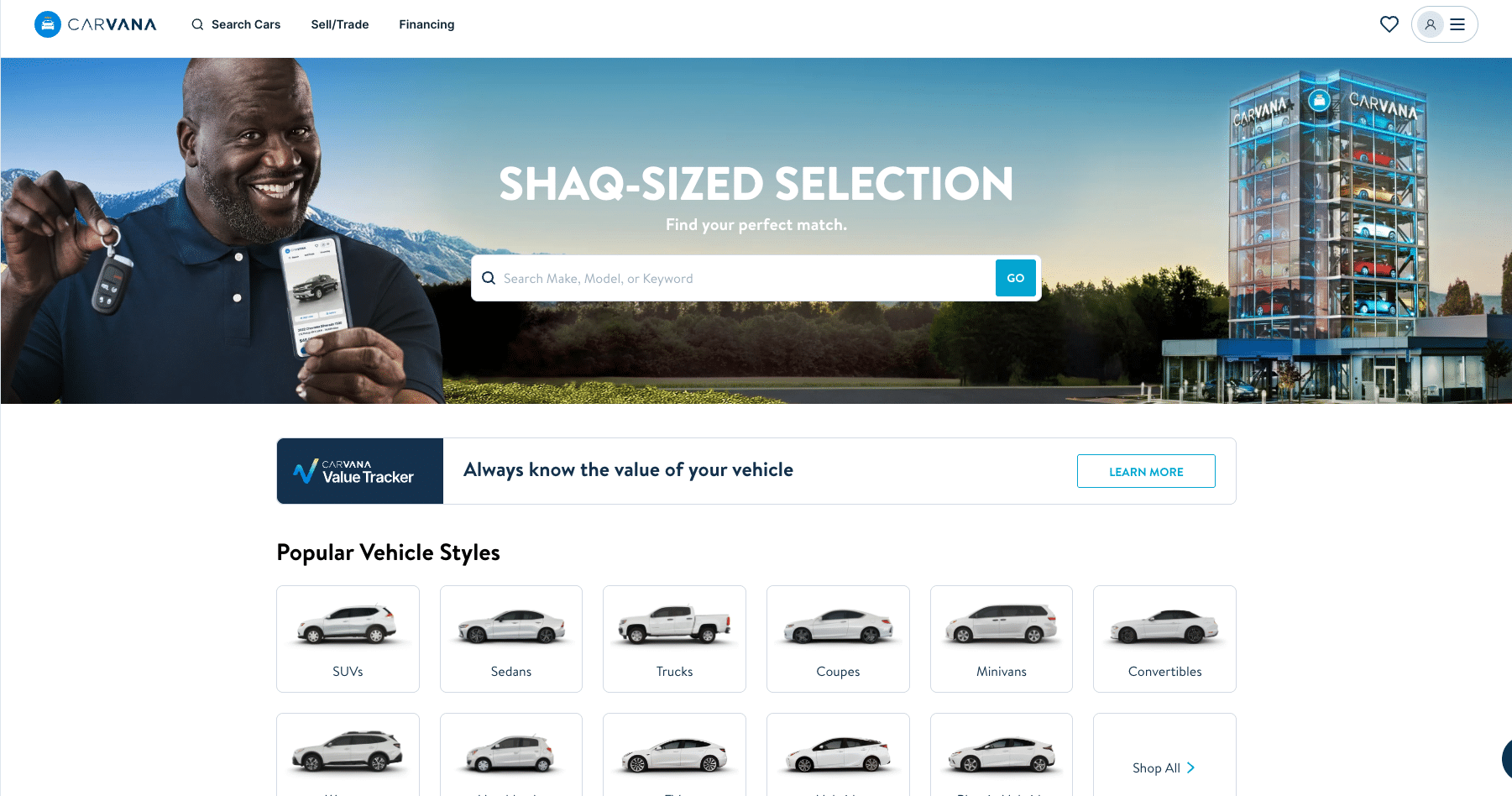
Carvana Homepage
Before getting into details, let’s examine background on Carvana:
Company overview (Founded 2012, Tempe, Arizona)
Carvana Co. was founded in 2012 and launched its online platform in 2013. It is headquartered in Tempe, Arizona and operates as an online used car retailer and financing provider.
Carvana’s business is built around a simple promise: buy or sell a used car online with transparent pricing and avoid the traditional dealership experience. That includes browsing inventory online, financing or paying in full and scheduling either delivery to your home or pickup at a Carvana vending machine.
Carvana has become a meaningful player in the used car market, with about 1.5% of total U.S. used car market share and over 2 million vehicles sold cumulatively through 2024. It reported $12.8 billion in revenue in 2023 and estimates suggest the business grew to roughly $14.2 billion across 2024-2025.
CEO Ernie Garcia III
Carvana’s CEO is Ernest Garcia III, who is also the company’s founder. This matters because a major part of the public narrative around Carvana is tied to the Garcia family ecosystem in used car sales and financing.
Business model (Fully online used car dealership)
Carvana functions like a dealership in outcomes but not in experience. It sells used vehicles entirely online, with fixed pricing that is non-negotiable. You can buy a car, trade in a car, finance the purchase through Carvana’s financing system or bring your own lender.
Carvana uses:
- A large online inventory (around 15,000 vehicles listed at a given time, based on comparisons commonly cited against CarMax)
- 360-degree vehicle visuals and condition disclosures
- Vehicle history reports (CarFax or AutoCheck) on listings
- A “test ownership” structure where the 7-day return policy effectively replaces a traditional test drive
Company size (2 Million+ vehicles sold)
Carvana has sold over 2 million vehicles cumulatively through 2024. That scale is part of the appeal and part of the risk. A high-volume online system can feel smooth when everything stays inside the rails. When it doesn’t, the recurring theme in Carvana reviews is that it can become slow and bureaucratic.
The famous car vending machines
Carvana’s most recognizable marketing asset is its “car vending machines,” which typically provide a choreographed pickup experience. Customers receive a commemorative coin, insert it into the machine and the vehicle is delivered via automated lift. Carvana advertises roughly 37-40 vending machines across 20 states, which makes vending machine pickup a real option for some buyers, but not most.
How Carvana differs from traditional dealerships
Carvana is built to remove the parts of dealerships that many buyers hate:
- No haggling
- No in-person pressure
- No sitting in an office while financing is “worked”
Instead, the experience is:
- Browse inventory online
- See your payment options
- Upload documents
- E-sign
- Schedule delivery or pickup
The trade-off is also clear in many Carvana reviews:
- You rely heavily on Carvana’s inspection and reconditioning
- You may not see the car in person until delivery day
- Customer service and title processing can become the choke points
Evaluate these top-rated lenders to find a better match for your credit tier:




Your Best Lending Partner: We match you with top lenders for the best deals. Fast, Easy Process: Quick approvals with expert support. Tailored Solutions: Flexible terms that fit your needs.


Is Carvana legit?
Now let’s answer the important question: Is Carvana a legitimate company? Read on to find out:
CFPB complaint data
There is no publicly disclosed enforcement action by the Consumer Financial Protection Bureau against Carvana as of early 2026.
However, Carvana’s financing arm, Bridgecrest Acceptance Corporation, falls under standard CFPB oversight as an auto lender. Consumer complaints related to financing typically involve:
- Higher-than-expected APRs
- Confusion around payment schedules
- Difficulty modifying or resolving loan servicing issues
These complaints are more common among subprime borrowers and align with broader industry patterns rather than unique allegations of fraud.
State attorney general actions (If any)
Carvana has faced documented enforcement actions at the state level, primarily related to title and registration delays.
Most notably:
- Connecticut (January 2025): A $1.5 million settlement with the state Attorney General, including customer restitution and civil penalties, tied to delayed titles and improper temporary registrations.
- Illinois and North Carolina: Temporary dealer license suspensions and probationary oversight during 2021–2022 for similar violations.
These actions do not suggest a scam operation, but they do confirm systemic compliance failures during periods of rapid growth.
Common Scam Concerns Addressed
Carvana is not a scam in the traditional sense. Vehicles are delivered, refunds are issued when returns are processed, and trade-in payments are made.
That said, common scam-related fears stem from:
- Paying thousands for a car before seeing it in person
- Waiting months for title paperwork
- Being unable to legally register or sell the vehicle
These issues are operational breakdowns, not fraudulent intent—but the outcome for affected customers can feel similar.
Our Legitimacy Assessment
Carvana is a legitimate, large-scale online auto retailer, not a fly-by-night operation. However, it carries higher execution risk than traditional dealerships and CarMax.
Buyers who succeed tend to:
- Use the 7-day return window aggressively
- Schedule an independent inspection immediately
- Track title progress closely
- Escalate quickly when delays occur
Buyers who assume the process will run hands-off are the most likely to experience frustration. Legitimacy is not the issue. Consistency is.
How the Carvana buying process works (Step by step)
Carvana’s biggest advantage is how streamlined the buying process feels—especially compared to a traditional dealership. Here’s how it works in real-world terms, not marketing copy.
Step 1: Browse inventory online
You start on Carvana’s website by filtering inventory by:
- Make, model and year
- Price and monthly payment
- Mileage and body style
- Features and drivetrain
Each listing includes 360-degree photos, a vehicle history report and a condition disclosure highlighting visible imperfections. This is where you should slow down. Zoom in. Read the notes. Assume anything not shown could still exist.
Step 2: Prequalify for financing (Optional)
You can check financing terms using a soft credit pull. This shows:
- Estimated APR
- Monthly payment
- Down payment requirement (if any)
Prequalification usually takes a couple of minutes and doesn’t affect your credit score. You can also skip this entirely and bring your own financing from a bank or credit union.
Step 3: Add a trade-in (optional)
If you’re selling a car, Carvana offers an instant online appraisal. You enter:
- VIN or license plate
- Mileage
- Basic condition questions
The offer is typically valid for 7 days. Trade-ins can be applied directly as a down payment or sold as a standalone transaction.
Step 4: Choose delivery or pickup
You’ll choose between:
- Home delivery, which may include a nonrefundable delivery fee depending on distance
- Vending machine pickup, which is free but only available in select cities
Delivery windows are scheduled in advance, but reschedules do happen—especially if a vehicle needs additional reconditioning.
Step 5: Upload documents and finalize the purchase
Before final approval, Carvana requires:
- Proof of income
- Driver’s license
- Insurance verification
- Bank information for down payment
At this stage, a hard credit pull occurs if you’re financing. Documents are signed electronically.
Step 6: Delivery day
On delivery or pickup day:
- A Carvana representative reviews the vehicle with you
- You receive temporary registration
- The 7-day return clock starts
This is where smart buyers immediately schedule an independent inspection.
Step 7: The 7-day test period
You can drive the vehicle for up to 400 miles during the return window. This is your real test drive. Use it:
- Take the car to a trusted mechanic
- Drive it on highways and local roads
- Test every feature
- Check tire age and wear
- Watch for warning lights
If you return the vehicle, Carvana will pick it up and process the refund. Delivery fees, however, are not refunded.
Step 8: Title and registration processing
After the return window closes, Carvana processes:
- Title transfer
- Permanent registration
- License plates
This step is where delays most commonly occur, and it’s the single biggest reason buyers regret the experience.
Carvana’s 150-point inspection
Carvana advertises a 150-point inspection on every vehicle it sells. On paper, that sounds thorough. In practice, carvana reviews show that the inspection is best viewed as a baseline screening—not a guarantee of mechanical perfection.
What the 150-Point inspection includes
According to Carvana, the inspection process is designed to ensure vehicles meet basic safety, mechanical and cosmetic standards before being listed. Key areas covered include:
- Engine and drivetrain: Fluid levels, leaks, abnormal noises, basic performance checks
- Brakes and suspension: Pad life, rotor condition, shocks and struts
- Steering and alignment: Steering response and basic handling
- Electrical systems: Lights, windows, infotainment, gauges and cameras
- Safety equipment: Airbags, seatbelts, backup cameras
- Exterior and interior condition: Paint, dents, scratches, upholstery, trim
- Tires: Tread depth and visible wear
Each listing also includes a condition report that flags visible cosmetic issues, usually with annotated photos.
Where the inspection often falls short
Despite the checklist, real-world reviews consistently point to gaps. The most common issues buyers report after delivery include:
- Old or mismatched tires that technically meet tread minimums but should be replaced soon
- Brake wear that passes inspection but leads to near-term replacement
- Suspension noise or vibration not detected in basic checks
- Cosmetic flaws that were either missed or downplayed in photos
- Alignment issues noticeable at highway speeds
None of these mean the inspection is fake—but they do mean it’s not a substitute for a full pre-purchase inspection by an independent mechanic.
Why is the inspection inconsistent
Carvana operates at scale. Vehicles move through centralized inspection and reconditioning centers under time pressure. That makes consistency difficult.
The inspection is designed to catch:
- Major safety issues
- Obvious mechanical failures
- Branded or salvage title problems
It is not designed to guarantee:
- Like-new condition
- Long remaining life on wear components
- Zero cosmetic surprises
How to protect yourself as a buyer
Smart buyers treat the 150-point inspection as a starting point, not the finish line.
Best practices:
- Schedule a full independent inspection immediately after delivery
- Check tire age (DOT code), not just tread depth
- Test drive at highway speeds
- Listen for suspension and brake noise
- Compare the delivered car closely against listing photos
If issues show up, document everything during the 7-day window.
Carvana’s 7-day return policy
Carvana’s 7-day return policy is one of its biggest selling points—and also one of the most misunderstood.
How the 7-day return policy works
After delivery or pickup, you have 7 calendar days to decide whether to keep the vehicle. During that window, you can drive up to 400 miles.
If you choose to return the car:
- Carvana schedules a pickup
- The purchase is reversed
- Financing is canceled or refunded
The return is no-questions-asked, as long as the vehicle is returned in substantially the same condition.
What is (and isn’t) refunded
This is where buyers need to pay attention.
Refunded:
- Vehicle purchase price
- Taxes and registration fees (once processed)
- Down payment
Not refunded:
- Delivery fees, which can range from a few hundred to over $1,000, depending on distance
That nonrefundable delivery fee is one of the most common frustrations cited in Carvana reviews.
How long refunds take
Refund timelines vary:
- Cash purchases are typically refunded within 5–10 business days
- Financed purchases may take longer due to lender’s processing
- Registration refunds can lag if the paperwork has already been submitted
Most buyers report that refunds eventually arrive, but patience is required.
Using the return window the right way
The 7-day window is not a casual grace period. It’s your inspection and verification window.
What to do immediately:
- Book an independent mechanic inspection
- Test all electronics and features
- Drive in varied conditions
- Verify VIN and title status
- Confirm the vehicle matches the listing description
If something feels off, don’t wait. Initiate the return early to avoid scheduling delays.
Common return mistakes to avoid
- Waiting until day six to inspect the car
- Assuming Carvana will proactively fix issues
- Driving more than 400 miles
- Missing cosmetic or mechanical issues early
- Forgetting that delivery fees are nonrefundable
Bottom line on the return policy
Carvana’s 7-day return policy is real and enforceable, and it provides meaningful protection—if you use it aggressively. Buyers who treat it as a true test period tend to walk away satisfied. Buyers who treat it as a formality are the ones who regret not returning the car when they had the chance.
Is Carvana’s pricing competitive?
Carvana’s pricing strategy is simple and very intentional: no haggling, no negotiation, no surprises at checkout. The price you see on the listing is the price you pay for the vehicle itself.
Whether that price is competitive depends on what you’re comparing it to—and how much you value convenience.
How Carvana prices its vehicles
Carvana prices vehicles using algorithmic market data rather than salesperson discretion. Listings are adjusted based on:
- Vehicle age and mileage
- Market demand and supply
- Comparable listings nationwide
- Condition and feature set
Because pricing is national rather than local, some cars are priced aggressively, while others are clearly above local dealership averages.
How Carvana prices compare to dealerships
In many customer reports, buyers report paying slightly more than a local used car lot, but less than what they would pay after fees and add-ons at a traditional dealership.
Key differences:
- No negotiation leverage
- No forced add-ons or protection packages
- No documentation fees
At a dealership, a lower sticker price can easily climb once fees, accessories, and financing markups are added. Carvana’s higher list price often reflects an “all-in” approach—minus delivery fees.
Hidden costs to watch for
Carvana doesn’t hide costs, but some buyers overlook them:
- Delivery fees (nonrefundable if you return the car)
- Sales tax and registration, which vary by state
- Financing costs, which can be higher for subprime borrowers
These aren’t unique to Carvana, but they do impact the final number.
When Carvana pricing makes sense
Carvana pricing tends to make sense if:
- You want to avoid negotiation entirely
- You value time and convenience
- You’re buying a popular, late-model vehicle
- You plan to return the car if anything feels off
For mainstream vehicles with stable market pricing, Carvana can be competitive enough to justify the premium.
When Carvana pricing is not ideal
Carvana pricing is often less attractive if:
- You’re shopping older or high-mileage vehicles
- You want the absolute lowest possible price
- You’re willing to negotiate in person
- You live close to multiple competitive dealers
In these cases, private-party sales or traditional dealers may offer better value.
Carvana financing options and APR ranges
Carvana offers built-in financing through its platform, primarily via its lending arm, Bridgecrest, with some third-party lender integration. Financing is optional—you can also bring your own lender or pay cash.
Prequalification and credit impact
Carvana allows buyers to prequalify with a soft credit pull, which does not affect your credit score. Prequalification shows estimated:
- APR
- Monthly payment
- Required down payment
A hard credit inquiry only occurs once you finalize the purchase.
Typical APR ranges
APR offers vary widely based on credit profile:
- Excellent credit: roughly mid-single-digit APRs
- Average credit: often high single digits to low teens
- Subprime credit: can reach the high teens or 20%+
Many Carvana reviews from subprime borrowers mention APRs that are higher than local credit unions but similar to other online auto lenders.
Down payments and loan terms
Carvana financing terms typically range from:
- 36 to 72 months, depending on vehicle age and credit
- Down payments may be required, especially for lower credit scores
Loan terms are transparent, with no prepayment penalties.
Bringing your own financing
You are free to use:
- Banks
- Credit unions
- Online auto lenders
However, some buyers report that using outside financing can slightly slow the checkout process due to additional verification steps.
Financing pros and cons
Pros:
- Fast approval
- Transparent terms
- No pressure from finance managers
Cons:
- Rates can be higher than credit unions
- Limited ability to negotiate APR
- Less flexibility for borderline credit cases
Bottom line on financing
Carvana financing prioritizes speed and simplicity over rate optimization. If convenience matters most, it works. If you want the lowest possible APR, shopping a credit union before committing is often the better move.
What to expect from the Carvana delivery process
Carvana’s delivery model is one of its biggest selling points—and also one of its most common sources of frustration. When it works, it feels effortless. When it doesn’t, delays and reschedules are the number-one complaint from customers.
Here’s what to expect in real-world terms.
Delivery options available
Carvana offers two delivery methods:
- Home delivery
- Vending machine pickup (only in select cities)
Vending machine pickup is free and usually smoother, but availability is limited. Most buyers use home delivery.
Delivery fees explained
Delivery fees vary based on distance from a Carvana logistics hub and local market demand. Fees commonly range from:
- $0 (rare, usually local inventory)
- $190–$590 (typical)
- $1,000+ for long-distance deliveries
Important detail: delivery fees are nonrefundable, even if you return the car during the 7-day window. This is one of the biggest cost-related complaints customers report.
Scheduling and reschedules
Once you check out, you’ll select a delivery date and time window. Carvana generally gives a multi-day range rather than a narrow appointment.
Reschedules happen more often than buyers expect. Common reasons include:
- Vehicle failing a final quality check
- Transportation delays
- Paperwork verification issues
- Reconditioning delays
Some buyers experience multiple reschedules before delivery actually occurs.
What happens on delivery day
On delivery day:
- A Carvana advocate arrives with the vehicle (or it’s released from the vending machine)
- You review the car in person
- You receive temporary registration paperwork
- The 7-day return clock begins
You are not required to sign anything acknowledging vehicle condition beyond receipt. This is your moment to document issues.
Common delivery issues reported
Recurring delivery-related complaints include:
- Missed delivery windows without notice
- Cosmetic damage from transport
- Vehicles arriving dirty or unprepped
- Missing accessories (second keys, floor mats, chargers)
If something is wrong, document it immediately with photos and contact support the same day.
Best practices for delivery day
To protect yourself:
- Take photos of the exterior and interior on arrival
- Verify mileage matches the listing
- Confirm VIN matches paperwork
- Test basic functions immediately
- Ask about missing items before the driver leaves
Selling your car to Carvana
Selling a car to Carvana is often smoother than buying one. Many sellers report that this side of the business works exactly as advertised.
How the selling process works
You start by entering:
- VIN or license plate
- Mileage
- Basic condition questions
Carvana generates an instant offer, typically valid for 7 days. You can either:
- Apply it toward a purchase, or
- Sell the vehicle outright for cash
Offer accuracy and competitiveness
Carvana offers are often competitive—sometimes even higher than local dealer bids, especially during periods of high used-car demand.
That said, offers can drop if:
- Mileage increases beyond the stated amount
- Condition changes
- Documentation doesn’t match inputs
Accuracy matters.
Pickup and payment timeline
Once accepted:
- Carvana schedules a pickup (or drop-off)
- The vehicle is inspected briefly
- Payment is issued via ACH or check
Many sellers report payment within 1–3 business days, sometimes even same-day.
Title and loan payoff handling
If your car has a lien:
- Carvana coordinates the payoff with the lender
- Any remaining equity is paid to you
This process generally works well, though payoff timelines can vary based on lender responsiveness.
Selling pros and cons
Pros:
- No negotiation
- Fast offers
- Easy scheduling
- Competitive pricing
Cons:
- Offers can expire quickly
- Condition disputes can lower the final payout
- Less flexibility than private sales
Bottom line on selling to Carvana
If you want a low-effort sale with predictable outcomes, Carvana is often a strong option. It’s not always the highest possible price, but it’s one of the easiest.
CarvanaCare extended warranty: Coverage, cost, and complaints
CarvanaCare is Carvana’s optional extended warranty program, administered by SilverRock. It’s meant to give buyers peace of mind after the 7-day return window ends—but this is also one of the most polarizing parts of the Carvana experience.
What CarvanaCare covers
CarvanaCare coverage varies by plan level and vehicle eligibility, but it generally includes major components such as:
- Engine and transmission
- Drive axle
- Steering components
- Air conditioning and heating
- Electrical systems (excluding wear items)
Coverage typically lasts up to 60 months or 100,000 miles, depending on the plan you select and the vehicle’s age and mileage at purchase.
What CarvanaCare does not cover
This is where many complaints arise. Like most vehicle service contracts, CarvanaCare excludes:
- Normal wear items (brake pads, rotors, tires, clutches)
- Cosmetic issues
- Maintenance services
- Pre-existing conditions
In many Carvana reviews, buyers report frustration when repairs they assumed were covered were denied as “wear and tear.”
Cost and deductibles
CarvanaCare pricing varies based on:
- Vehicle make and model
- Mileage
- Coverage length
Costs are typically rolled into the monthly payment if you’re financing. Deductibles usually range from $0 to $100, depending on repair location and plan terms.
Repair process and SilverRock complaints
CarvanaCare claims are handled by SilverRock, not directly by Carvana. This distinction matters.
Common complaints include:
- Delays in repair authorization
- Disputes over what qualifies as a covered repair
- Limited approved repair facilities in some areas
- Out-of-pocket costs due to partial denials
Some buyers report smooth experiences, especially when using in-network repair shops. Others describe long approval timelines and inconsistent communication.
Is CarvanaCare worth it?
CarvanaCare can make sense if:
- You’re buying a higher-mileage vehicle
- You want predictable repair costs
- You’re comfortable using approved repair facilities
It’s less appealing if:
- You already have manufacturer warranty coverage
- You prefer full control over repair shops
- You expect near-total coverage
Carvana title transfer and registration
If there’s one issue that consistently dominates negative Carvana reviews, it’s title and registration delays.
How title and registration are supposed to work
After your 7-day return window closes, Carvana is responsible for:
- Transferring the vehicle title
- Registering the car with your state DMV
- Issuing permanent license plates
You receive temporary registration at delivery, which is meant to cover the gap while paperwork is processed.
Common title and registration delays
Many buyers report delays lasting weeks or even months. The most common issues include:
- Expired temporary tags
- Incomplete or incorrect paperwork
- Lost documents between Carvana and state DMVs
- Difficulty getting status updates
In extreme cases, buyers report being unable to legally drive the car while waiting for plates.
Regulatory actions and enforcement
These delays have triggered real enforcement action. Multiple states have fined or temporarily suspended Carvana’s dealer licenses in the past for failing to complete title transfers within legal timelines. A $1.5 million settlement with the Connecticut Attorney General in 2025 addressed similar violations.
What buyers can do to protect themselves
To reduce risk:
- Track your temporary tag expiration date
- Follow up weekly once the return window closes
- Escalate quickly if deadlines are missed
- File formal complaints if necessary
Many buyers report that filing complaints with the BBB or state regulators is what finally gets stalled cases moving.
Bottom line on title and registration
Carvana’s title processing is its weakest operational link. While many buyers eventually receive their plates and title, the uncertainty and delays are the top reason some regret using the platform.
Real customer reviews of Carvana
Customer feedback about Carvana is unusually polarized. Reviews across platforms show that buyers either experience a smooth, modern purchase or run into serious post-sale issues. The themes are consistent regardless of platform.
Trustpilot reviews

Carvana Trustpilot profile
On Trustpilot, Carvana holds an average rating of around 2.9 out of 5 stars based on 11,000+ reviews. The distribution is heavily split, with a large number of 5-star reviews and a similarly large share of 1-star reviews.
Positive Trustpilot reviews commonly cite:
- Easy online checkout
- No-haggle pricing
- Helpful delivery staff
- A smooth return process when used early
Negative Trustpilot reviews frequently mention:
- Delivery delays and reschedules
- Vehicles arriving with undisclosed issues
- Difficulty reaching customer service
- Long waits for registration and plates
BBB reviews and complaints

Carvana Better Business Bureau (BBB)
Carvana is not accredited by the Better Business Bureau and is currently listed as Not Rated. Over the past three years, the BBB has logged 4,900+ complaints against Carvana.
Common complaint themes include:
- Title and registration delays
- Delivery and logistics issues
- Customer service responsiveness
- Billing and collection disputes
Carvana responds to most complaints, but resolution satisfaction varies. Many consumers report that filing a BBB complaint is often necessary to trigger escalation.
ConsumerAffairs reviews
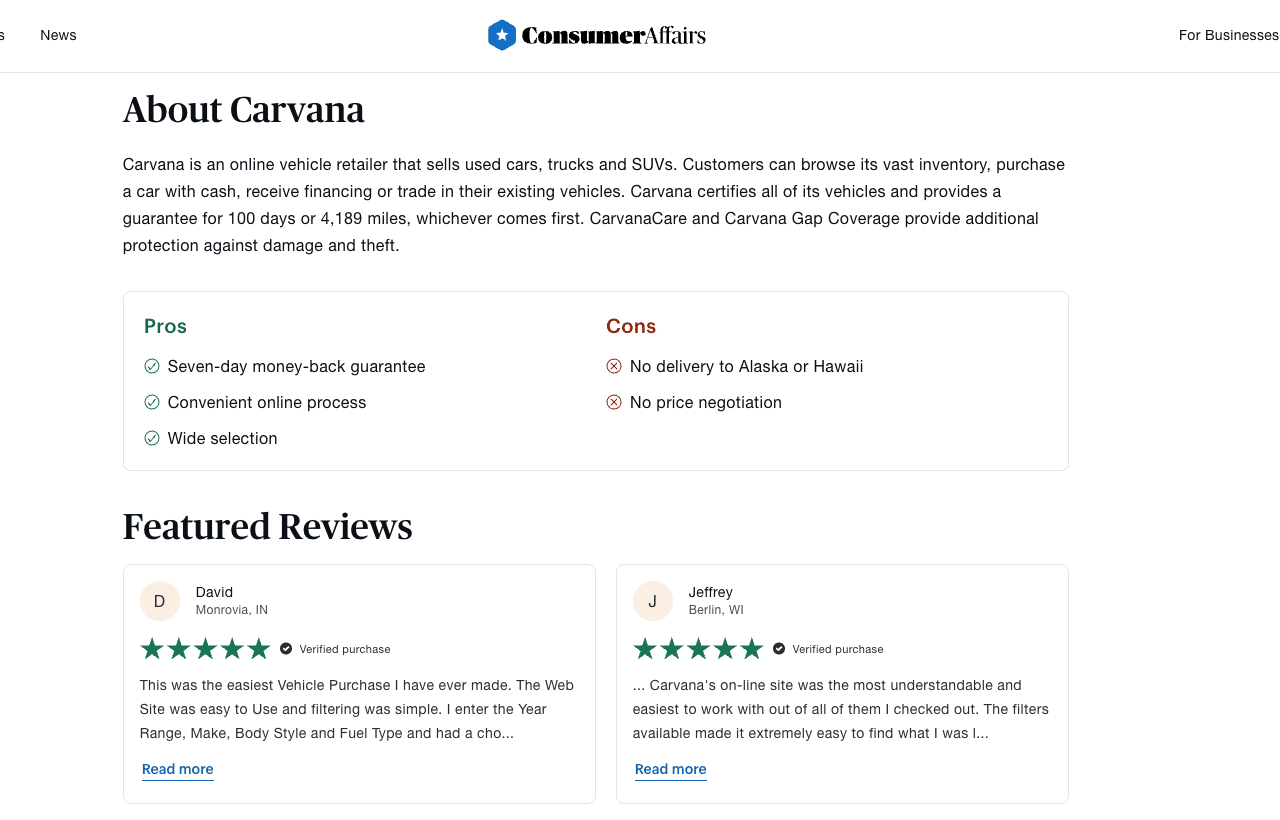
ConsumerAffairs Summary
On ConsumerAffairs, Carvana reviews skew negative, particularly around post-sale support and warranty issues. A large portion of complaints involve:
- Disputes over SilverRock warranty coverage
- Delays approving repairs
- Out-of-pocket costs for issues discovered shortly after delivery
While some buyers report smooth resolutions, ConsumerAffairs feedback suggests inconsistency in how problems are handled once the sale is complete.
Google reviews
Google review ratings vary widely by location, especially for vending machine hubs and regional delivery centers. Ratings typically range from 2.5 to 4+ stars, depending on the market.
Higher-rated locations often mention:
- Friendly on-site staff
- Smooth pickup experiences
- Faster local processing
Lower-rated locations frequently cite:
- Delivery damage
- Poor communication
- Long waits for plates and registration
Reddit Feedback (r/carvana, r/askcarsales)
On Reddit, discussions in r/carvana and r/askcarsales tend to be more candid and detailed. Many posts confirm patterns seen elsewhere:
- Smooth experiences when everything goes right
- Major frustration when title or delivery issues arise
Reddit users often emphasize the importance of using the 7-day return window aggressively and scheduling independent inspections immediately.
Common praise (Convenience, no haggling, easy process)
Across all platforms, the most common praise includes:
- Fully online purchase process
- No negotiation or sales pressure
- Transparent pricing
- Competitive trade-in offers
- The 7-day return policy
Many buyers describe Carvana as the least stressful car-buying experience they’ve had—when it works.
Common complaints (Vehicle condition, delays, customer service, title issues)
Recurring complaints are consistent across platforms:
- Vehicles arriving with mechanical or cosmetic issues
- Delivery delays and reschedules
- Slow or difficult customer service escalation
- Title and registration delays
These issues are the primary reason some buyers advise caution despite the platform’s convenience.
Carvana pros and cons
Here are the standout aspects of Carvana, and where they fall short:
Advantages
- Fully online buying experience
- No haggling or pressure
- Transparent, upfront pricing
- Easy trade-in process
- 7-day return window
- Nationwide inventory
Disadvantages
- Nonrefundable delivery fees
- Inconsistent inspection quality
- Title and registration delays
- Slow issue resolution
- Warranty claim disputes
- Limited in-person support
Who should use Carvana?
Carvana works best for a very specific type of buyer. If you fall into that group, the platform can save you time and stress. If you don’t, it can feel frustrating fast.
Ideal buyers
Carvana is a strong fit for buyers who:
- Value convenience over price optimization
- Strongly dislike traditional dealerships and sales pressure
- Know the exact make, model, and trim they want
- Are comfortable buying based on photos, history reports, and condition notes
- Plan to use the 7-day return window aggressively
- Are purchasing newer, mainstream vehicles with lower mileage
These buyers tend to report smooth experiences because they treat Carvana as a logistics platform, not a concierge service.
Who Should Look Elsewhere
Carvana is usually not ideal for buyers who:
- Want the lowest possible price through negotiation
- Prefer multiple in-person test drives before buying
- Are shopping older, high-mileage, or specialty vehicles
- Need a vehicle immediately due to expiring registration or relocation
- Want hands-on support throughout the process
In these cases, local dealerships, private sellers, or platforms like CarMax often provide better value or flexibility.
Common Carvana problems and how to avoid them
Most negative Carvana reviews fall into a handful of predictable categories. Knowing them in advance dramatically improves your odds of a good outcome.
Undisclosed vehicle damage
Some buyers report cosmetic or minor damage that was not clearly shown in listing photos.
How to avoid it:
- Zoom in on all listing images
- Read the condition report carefully
- Compare delivered vehicle against photos immediately
- Document any discrepancies with photos on delivery day
Mechanical issues after purchase
Mechanical problems sometimes appear shortly after delivery, especially on higher-mileage vehicles.
How to avoid it:
- Schedule an independent inspection within 48 hours
- Test drive in multiple conditions
- Don’t assume the 150-point inspection replaces a mechanic
Delivery delays
Rescheduled or delayed deliveries are one of the most common complaints.
How to avoid it:
- Avoid tight delivery timelines
- Monitor delivery status frequently
- Be prepared for reschedules, especially for long-distance delivery
Title and registration problems
Title and registration delays are Carvana’s most serious recurring issue.
How to avoid it:
- Track your temporary tag expiration date
- Follow up weekly after the return window
- Escalate early if deadlines approach
- Keep all paperwork and communication documented
Customer service difficulties
Customer service can feel slow or fragmented when issues arise.
How to avoid it:
- Keep a written log of all contacts
- Ask for escalation early
- Use formal complaint channels if needed
Tips to protect yourself
The safest way to use Carvana:
- Treat the 7-day return window as mandatory due diligence
- Schedule inspections immediately
- Document everything
- Escalate issues early
- Be willing to return the car if something feels off
Carvana vs. competitors
How Carvana stacks up depends on what you value most: convenience, price, certainty, or control. Here’s a clean, apples-to-apples breakdown against the most common alternatives.
Carvana vs. Vroom
Vroom operates on a similar online-only model, but customer sentiment has diverged sharply.
- Inventory & UX: Both offer nationwide inventory and online checkout. Carvana’s interface and photos are generally clearer.
- Delivery: Carvana is more reliable overall; Vroom has been criticized for frequent delivery breakdowns.
- Title & Registration: Both have struggled, but Vroom’s issues have historically been more severe and prolonged.
- Returns: Carvana offers a 7-day return window; Vroom’s return policies have been narrower and more restrictive.
Bottom line: Between the two, Carvana is widely viewed as the safer bet in 2026.
Carvana vs. CarMax
CarMax is Carvana’s most direct, credible competitor.
- Pricing: CarMax prices are often similar or slightly higher, but include in-person inspection and support.
- Inspection Quality: CarMax’s reconditioning is generally considered more consistent.
- Returns: CarMax offers a 10-day return window (longer than Carvana’s 7 days).
- Experience: CarMax blends online shopping with physical locations, which many buyers find reassuring.
Bottom line: If you want certainty and in-person support, CarMax often wins—even if it costs a bit more.
Carvana vs. Traditional Dealerships
Traditional dealerships vary wildly, but the trade-offs are clear.
- Negotiation: Dealerships allow negotiation; Carvana does not.
- Fees: Dealerships often add documentation and add-on fees; Carvana’s pricing is cleaner.
- Test Drives: Dealerships allow test drives before purchase; Carvana relies on the return window.
- Support: Dealerships offer face-to-face resolution when problems arise.
Bottom line: Dealerships offer more control and leverage; Carvana offers speed and simplicity.
Carvana vs. Private Sellers
Private-party sales can offer the lowest prices—but also the highest risk.
- Price: Private sellers are usually cheaper.
- Protection: No return policy, no warranty, no recourse after purchase.
- Convenience: More time, coordination, and risk involved.
Bottom line: Private sellers are best for experienced buyers who prioritize savings over safety nets.
Carvana contact information
If something goes wrong with Carvana, knowing where and how to reach support matters.
Customer service phone
Carvana customer support can be reached at: 800-333-4554
This number handles buying, selling, delivery, and post-sale issues.
Hours of operation
Customer service hours vary slightly by department, but are generally:
- Monday–Friday: 8 a.m. to 9 p.m. (local time)
- Saturday–Sunday: 8 a.m. to 7 p.m. (local time)
Hold times can increase significantly during delivery delays or title issues.
Live chat
Carvana offers live chat support through its website and mobile app. Chat is often faster than phone support for:
- Order status updates
- Document uploads
- Delivery scheduling
For complex issues (title delays, refunds), phone support is usually required.
Help center
Carvana’s online Help Center includes FAQs and self-service tools for:
- Order tracking
- Document submission
- Financing questions
- Returns and refunds
Many buyers report that while the Help Center is useful for basics, escalation still requires direct contact.
Frequently asked questions
Is Carvana legit?
Yes — Carvana is a real, legitimate company. It’s publicly traded, licensed nationwide, and has sold millions of cars. That said, legit doesn’t mean flawless. Carvana’s issues aren’t about fraud or scams — they’re about execution: title delays, uneven inspections, and customer service bottlenecks when things go wrong.
Bottom line: it’s not fake, but it requires an informed buyer.
Is Carvana worth it?
It depends on what you value most.
If you want speed, convenience, and zero negotiation stress, Carvana can feel like a breath of fresh air. If you want the absolute lowest price or need guaranteed fast paperwork, it may frustrate you.
Think of Carvana as paying a convenience premium — sometimes in dollars, sometimes in patience.
Can you negotiate with Carvana?
No. Prices are fixed and non-negotiable.
For some buyers, that’s a relief. No games, no back-and-forth, no finance manager theatrics. For others, it’s a deal-breaker — especially if you’re used to grinding out discounts at dealerships or buying private party.
Does Carvana do a credit check?
Yes — but in two stages.
Carvana lets you pre-qualify with a soft credit pull, which doesn’t affect your score. Once you commit to a purchase and financing, a hard inquiry happens, just like with any auto loan.
Pro tip: if your credit is solid, bring a credit union pre-approval. Carvana accepts outside financing, and it can save you real money.
How long does Carvana delivery take?
When things go smoothly, delivery can be quick. When they don’t, delays happen — sometimes more than once.
Most buyers fall somewhere in the middle. The key thing to understand is that delivery dates are not guarantees. Vehicles can get pulled for reconditioning, inspection issues, or logistics problems mid-stream.
If timing is critical, build in buffer room.
Final Verdict: Is Carvana worth it?
Let’s draw from everything we’ve learned and answer the question: Is Carvana worth using?
Overall assessment
Carvana is neither a miracle nor a disaster. It’s a high-convenience system with real operational weak spots.
When it works, it’s one of the easiest ways to buy a used car. When it doesn’t, the lack of local accountability can be maddening.
When Carvana makes sense
Carvana is a strong option if you:
- Know exactly what car you want
- Hate negotiating
- Value time over price
- Are comfortable managing the process proactively
- Can tolerate paperwork delays if needed
When to choose alternatives
You should probably look elsewhere if you:
- Need guaranteed fast title and registration
- Want to test drive before committing
- Are shopping on a tight budget
- Prefer in-person problem resolution
In those cases, CarMax, a local dealer, or private sellers may be a better fit.
Our recommendation
Carvana can be worth it — but only if you buy with your eyes open.
Use the 7-day window aggressively. Get an independent inspection immediately. Track your paperwork. Escalate early if something feels off.
If you want maximum control and minimum friction, Carvana can deliver. If you want certainty and hand-holding, choose a more traditional route.


Sponsored Advertising Content:
Advertorial or Sponsorship User published Content does not represent the views of the Company or any individual associated with the Company, and we do not control this Content. In no event shall you represent or suggest, directly or indirectly, the Company's endorsement of user published Content.
The company does not vouch for the accuracy or credibility of any user published Content on our Website and does not take any responsibility or assume any liability for any actions you may take as a result of reading user published Content on our Website.
Through your use of the Website and Services, you may be exposed to Content that you may find offensive, objectionable, harmful, inaccurate, or deceptive.
By using our Website, you assume all associated risks.This Website contains hyperlinks to other websites controlled by third parties. These links are provided solely as a convenience to you and do not imply endorsement by the Company of, or any affiliation with, or endorsement by, the owner of the linked website.
Company is not responsible for the contents or use of any linked website, or any consequence of making the link.
This content is provided by New Start Advantage LLC through a licensed media partnership with Inquirer.net. Inquirer.net does not endorse or verify partner content. All information is for educational purposes only and does not constitute financial advice. Offers and terms may change without notice.


