
Advertorial or Sponsorship User published Content does not represent the views of the Company or any individual associated with the Company, and we do not control this Content. In no event shall you represent or suggest, directly or indirectly, the Company's endorsement of user published Content.
The company does not vouch for the accuracy or credibility of any user published Content on our Website and does not take any responsibility or assume any liability for any actions you may take as a result of reading user published Content on our Website.
Through your use of the Website and Services, you may be exposed to Content that you may find offensive, objectionable, harmful, inaccurate, or deceptive.
By using our Website, you assume all associated risks.This Website contains hyperlinks to other websites controlled by third parties. These links are provided solely as a convenience to you and do not imply endorsement by the Company of, or any affiliation with, or endorsement by, the owner of the linked website.
Company is not responsible for the contents or use of any linked website, or any consequence of making the link.
Marcus by Goldman Sachs Reviews and Ratings

Marcus by Goldman Sachs Logo
If you’re researching reviews of Marcus by Goldman Sachs, you’re likely trying to decide if they are the right high-yield savings account to park your hard-earned money.
In this review, we’ll break down everything Marcus actually offers, how much it costs, and what real customers are saying across BBB reviews, TrustPilot reviews, and Reddit reviews. Our goal is to help you make an informed decision on whether they will be worth it for you to use. So without further ado, let’s get started.
TL;DR: Summary
- Marcus offers a 4.50% APY online savings account with no fees and FDIC insurance.
- Simple platform, but no checking, no debit card, no ATM access, and limited app features.
- Major complaints: sudden account closures, locked funds, and slow customer service.
- Good as a secondary place to park cash, not as a primary bank.
- Competitors like Ally, Synchrony, and SoFi often offer higher APYs with fewer issues.




What is Marcus by Goldman Sachs?
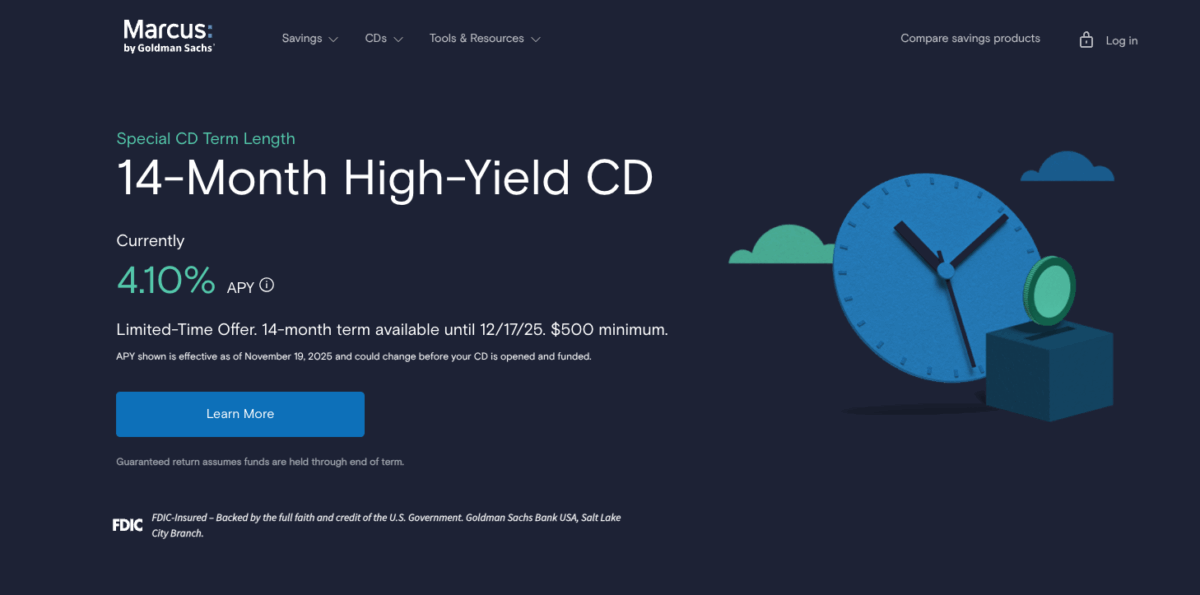
Marcus 14-Month High-Yield CD 4.10 APY
Marcus launched in 2016 as the consumer banking arm of The Goldman Sachs Group, Inc. Headquartered at 11850 S Election Rd, Draper, Utah, Marcus operates entirely online, so no branches, no tellers, no ATMs. Instead, it focuses on digital savings products.
The bank is a direct subsidiary of Goldman Sachs Bank USA, which means deposits are FDIC-insured up to $250,000 per individual or $500,000 for joint accounts. At its peak, Marcus attracted more than 14 million customers and over $110 billion in deposits.
But despite the flashy numbers, Goldman admitted Marcus has been a money-losing venture — burning through an estimated $5 billion in investment and posting $1.2 billion in losses in 2022 alone.
Leadership: Marcus’ executive team includes Harit Talwar (CEO), Omer Ismail (COO), and Anu Bhavnani (Managing Director), operating under Goldman Sachs Chairman and CEO David Solomon.
Financial performance: The parent company reported $53.51 billion in revenue for 2024 (a 15.7% increase from 2023) and $56.21 billion TTM as of June 2025.
Marcus holds BBB accreditation (since 2018) with an A+ rating for its deposit services. Still, Goldman Sachs’ broader profile shows mixed grades, including a C+ in San Francisco and non-accreditation in New York due to unresolved complaints and regulatory actions.
The platform is squarely targeted at savers, and not everyday banking customers. Marcus doesn’t offer checking accounts, debit cards, or ATMs. Instead, it markets to people who want a high-yield place to park cash while maintaining their primary banking elsewhere.
Your Best Lending Partner: We match you with top lenders for the best deals. Fast, Easy Process: Quick approvals with expert support. Tailored Solutions: Flexible terms that fit your needs.

What does Marcus by Goldman Sachs actually offer?
So what does Marcus actually offer right now? Let’s break it down.
Marcus Online Savings Account
The flagship product is Marcus’ high-yield online savings account. As of August 2025, it pays 4.50% APY with no minimum balance requirement and no monthly maintenance fees. Funds can be deposited via ACH transfer, direct deposit, mailed checks, or domestic wires, with a maximum account balance of $1 million.
Example usage of Savings Account
Let’s say you deposit $20,000 into a Marcus online savings account at the current 4.50% APY. If you leave it untouched for a full year, you would earn about $900 in interest. Since Marcus compounds interest daily and pays it monthly, you’ll see the balance steadily tick upward each month without having to do anything.
By comparison, a traditional brick-and-mortar bank offering just 0.01% APY would net you only $2 for the entire year on that same balance. That gap is why so many customers use Marcus as a secondary savings hub. Even with its limited features, the returns are simply far higher than what most big-name banks pay.
Marcus High-Yield Certificates of Deposit
Marcus offers standard CDs with terms from 6 months to 6 years, with rates ranging from 3.85% to 4.40% APY. The minimum deposit is $500, and early withdrawals come with steep penalties (90 to 270 days of interest depending on term length).
Marcus No-Penalty CD
For those wanting flexibility, Marcus has no-penalty CDs available in 7-, 11-, and 13-month terms, currently paying between 3.90% and 4.15% APY. After the first seven days, you can withdraw funds without penalty.
Rate Bump CD
Marcus also offers a 20-month “Rate Bump” CD at 3.90% APY, which allows one rate increase during the term if market conditions improve.
Digital experience and mobile banking
The Marcus app is designed for simplicity — you can open an account, transfer funds, and manage CDs without paperwork. That said, features are limited. There’s no mobile check deposit, no bill pay, and no debit card access. Transfers are capped at $125,000 via ACH and $50,000 per month via wire.
Discontinued products
Marcus has pulled back on a number of fronts:
- Personal loans (discontinued in December 2022, portfolio sold off)
- Marcus Invest (sold to Betterment in 2024, with all accounts transitioned)
- GM-branded credit cards (closed to new applicants, winding down)
- A beta checking account project (shut down before launch)

Does Marcus by Goldman Sachs have any fees?
One of Marcus’ strongest selling points is its near-zero fee structure.
Fee Types
- Savings and CDs have no monthly maintenance fees, no minimum balance fees, and no overdraft fees.
- ACH transfers are free, with limits up to $125,000 per transaction.
- Same-day transfers are free for amounts up to $100,000.
- Domestic wires are allowed up to $50,000 per month, though fees may apply depending on method.
- International wires are not supported.
CD Penalties
For early CD withdrawals, expect to lose:
- 90 days of interest for terms of 1 year or less
- 180 days of interest for terms 1–5 years
- 270 days of interest for terms over 5 years
- No-penalty CDs avoid this, provided you wait 7 days before withdrawing.
Transparency
Marcus is upfront about its rates and fees on its website. However, customers have flagged one glaring clause: accounts can be closed “at any time for any reason without notice.” That’s far broader than industry norms, and it has fueled some of the biggest customer complaints.
Industry Comparison
Marcus beats most traditional banks on cost. Where others charge $5–15 monthly fees or $25–50 for wires, Marcus charges nothing for most standard transactions. But rate leaders like Ally, Synchrony, and Discover have pulled ahead on APY, with some now topping 5%.
What are customers saying about Marcus by Goldman Sachs?
Customers use and benefit from Marcus by Goldman Sachs, but there are some serious challenges involved. Let’s take a look:
Better Business Bureau (BBB) reviews
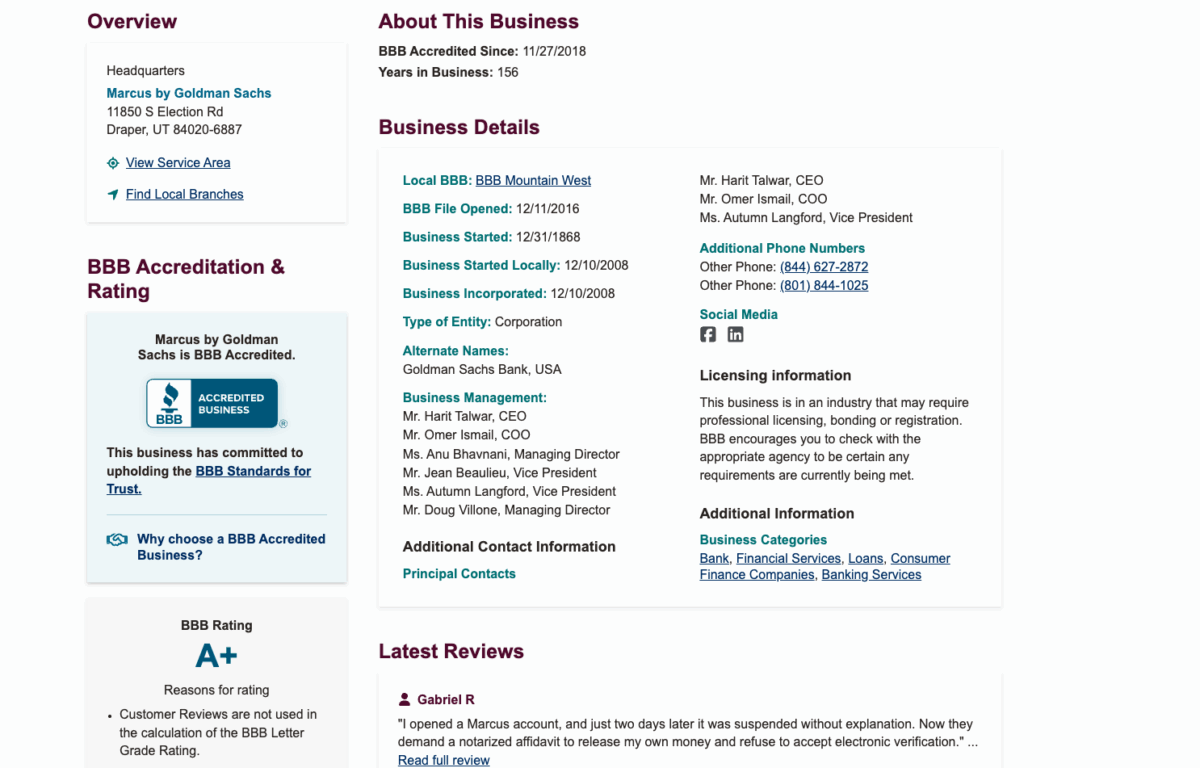
Marcus by Goldman Sachs BBB Profile A+ Rating
Marcus by Goldman Sachs is BBB-accredited and currently holds an A+ rating, but customer reviews tell a very different story. While the A+ reflects BBB’s internal criteria (not customer sentiment), Marcus has accumulated 1,400+ complaints since 2018.
Key BBB Profile Details
- BBB Rating: A+
- Accredited Since: November 27, 2018
- Headquarters: Draper, Utah
- Years in Business: 156 (Goldman Sachs corporate lineage)
- Additional Info: Marcus by Goldman Sachs is a wholly owned subsidiary of The Goldman Sachs Group Inc.
- Listed Executives: Harit Talwar (CEO), Omer Ismail (COO), Anu Bhavnani (Managing Director), and others
Most Common BBB Complaints
Customer reports consistently highlight:
- Sudden account closures or suspensions without explanation
- Funds locked for long periods, sometimes requiring notarized affidavits to release
- Identity verification failures even for long-time customers
- Security issues leading to repeated lockouts
- Slow, inconsistent, or unhelpful customer service
BBB’s latest posted reviews show examples of:
- Accounts are being suspended within days of opening
- Customers are unable to retrieve their own money without notarized documents
- Accounts are repeatedly compromised even after being locked
Overall BBB Sentiment
Despite the A+ rating, customer satisfaction is poor. The volume and consistency of complaints point to systemic issues with verification, account access, and customer support.
Bottom line: Marcus looks strong on paper with its accreditation and rating, but BBB customer experiences are overwhelmingly negative.
Trustpilot reviews
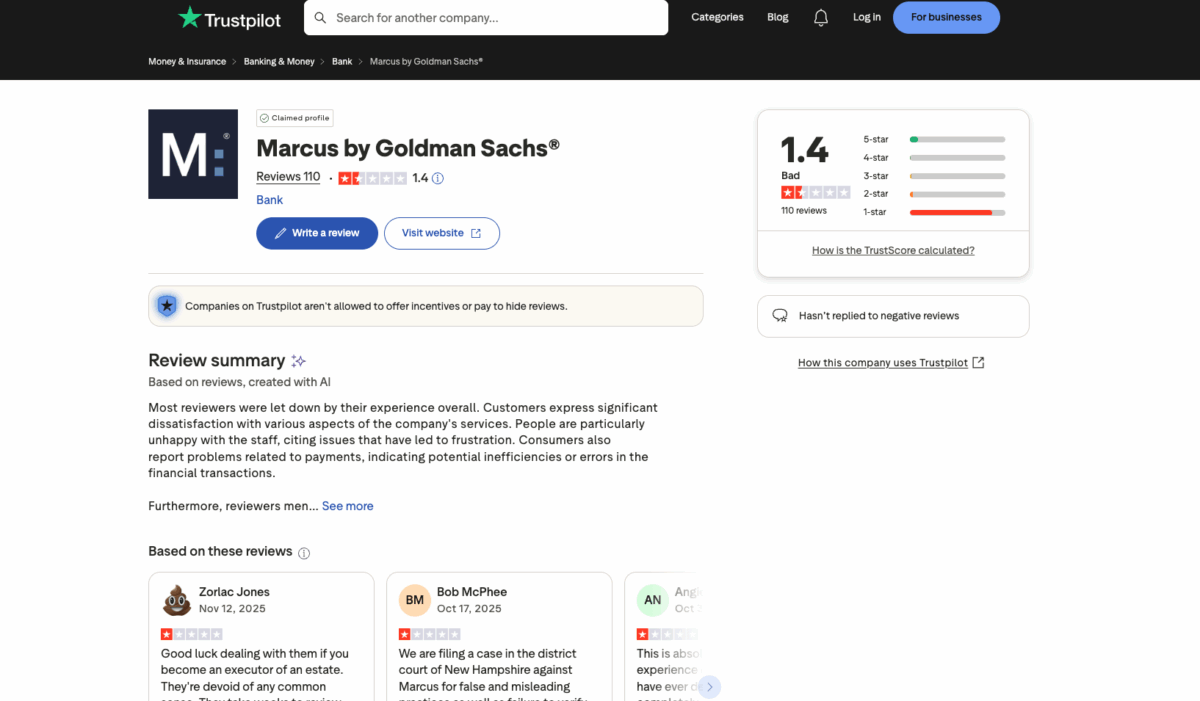
Marcus by Goldman Sachs Trustpilot Reviews 1.4 Rating
On Trustpilot, Marcus earns just 2.8 out of 5 stars across 100+ reviews. Positive comments mention “good rates” and “easy online setup.” Negative reviews dominate: “account locked without warning,” “funds held for months,” and “customer service impossible to reach.”
A standout quote:
“I had sent money to Marcus for over 10 years and had many CDs… At the end of Dec. 2024 I got a call saying they were going to close all my accounts… for a grand total of almost half a million.”
Reddit reviews
On Reddit, threads in r/Banking and r/MarcusInvest show a split picture. Users praise the 4.5% APY and slick app, but many warn of sudden account closures and no recourse:
“Marcus closed my account suddenly and without reason.”
Smart Money People (UK)
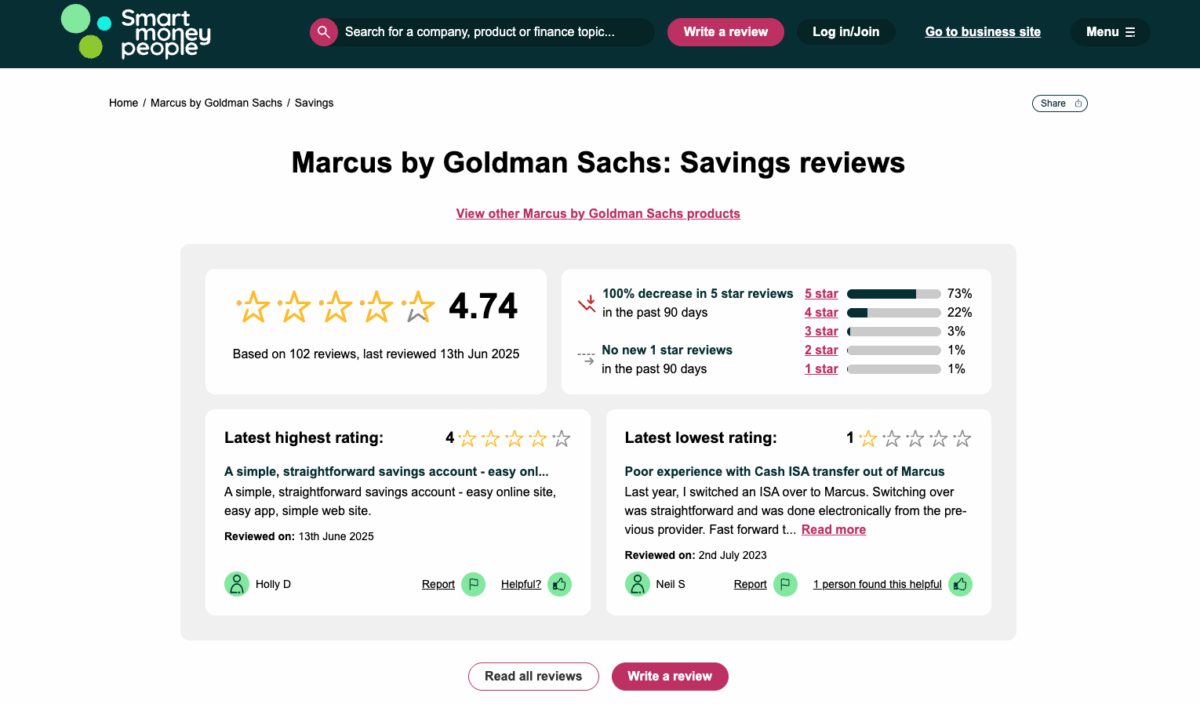
Marcus by Goldman Sachs UK Reviews Smart Money People
Interestingly, Marcus’ UK operation earns 4.66/5 stars. But even there, five-star reviews have dropped 67% in the past three months.
What can I expect from using Marcus by Goldman Sachs?
Marcus’ deposit growth was impressive, topping $110 billion across 14 million accounts. Applications are usually processed in under 24 hours if identity checks go smoothly.
But that’s the catch: thousands of reports show verification failures even for people with spotless credit histories. Customers often lose access while traveling abroad or changing phone numbers, since the system relies almost entirely on text-based verification.
Renewal rates on CDs hover around 65%, but churn is high. An estimated 5–8% of accounts are closed annually. Some by customers, many by Marcus itself.
On APY, Marcus remains competitive but no longer leads the pack. Other banks have surpassed their 4.5% rate with 5%+ offers.
Pros and Cons of Marcus by Goldman Sachs
Despite the name credibility of Goldman Sachs, Marcus is not a perfect high-yield savings account option. Here’s a breakdown of the areas that it shines in, and where it falls a bit flat:
Pros
- High APY on savings (4.50%)
- No monthly maintenance or overdraft fees
- Nationwide availability in all 50 states
- FDIC-insured and backed by Goldman Sachs
- Easy online interface
Cons
- No checking accounts, debit cards, or ATMs
- Limited app features (no mobile check deposit, no bill pay)
- Frequent reports of sudden account closures
- Identity verification system prone to failure
- Customer service is slow and inconsistent
- Rates have fallen behind top competitors
Who is the ideal candidate to use Marcus by Goldman Sachs?
Marcus is not a seamless fit for anyone who wants to store their money in a savings account. Here’s a breakdown of what the ideal Marcus candidate looks like, and who would be better off looking elsewhere:
Best For
- Savers looking to park emergency funds or short-term cash
- People who want a high-yield side account separate from their main bank
- Customers who are comfortable managing accounts entirely online
Not recommended for
- Anyone needing a primary checking account or debit access
- International travelers who can’t maintain a US phone number
- Customers who value responsive customer service
- People sensitive to account access risks
Is Marcus by Goldman Sachs actually worth it?
Marcus by Goldman Sachs is a mixed bag. On one hand, it delivers strong savings rates, no fees, and the security of FDIC insurance. On the other hand, it has serious issues with account closures, identity verification, and customer service.
If you want a high-yield savings account as a secondary place to stash cash, Marcus may work. But don’t make it your primary bank, and be prepared for possible headaches if their systems flag your account.
If you’re aware of the potential drawbacks and wish to proceed with using Marcus as your high-yield savings account, you can go directly to their website and check their rates: https://www.marcus.com/us/en
Alternatives to consider:
Before committing to Marcus, you may want to consider these other options that offer different sets of advantages and drawbacks:
- Ally Bank – 5.00% APY, robust app with checking and ATM access
- Synchrony Bank – 4.75% APY with debit card options
- Discover Bank – High-yield savings plus full checking services
- SoFi – Hybrid checking/savings with 4.6% APY and ATM access
Frequently asked questions about Marcus by Goldman Sachs
- Is Marcus by Goldman Sachs FDIC insured and safe for large deposits? Yes. Deposits are insured up to $250,000 per depositor ($500,000 joint) through Goldman Sachs Bank USA.
- Why does Marcus by Goldman Sachs close accounts without warning? Marcus reserves the right to close accounts “at any time for any reason,” often triggered by verification failures, travel, or account monitoring flags.
- How do I withdraw money from Marcus if they don’t have ATM cards? Funds must be transferred to an external bank account via ACH or wire. There is no debit or ATM access.
- Can I use Marcus if I travel internationally? Not reliably. Customers report frequent account locks when traveling abroad, as Marcus requires a US phone number for verification.
- What happens to my CD if Goldman Sachs exits consumer banking? Existing CDs would continue under FDIC coverage. Goldman would likely transfer accounts to another bank if it exits the space.


Sponsored Advertising Content:
Advertorial or Sponsorship User published Content does not represent the views of the Company or any individual associated with the Company, and we do not control this Content. In no event shall you represent or suggest, directly or indirectly, the Company's endorsement of user published Content.
The company does not vouch for the accuracy or credibility of any user published Content on our Website and does not take any responsibility or assume any liability for any actions you may take as a result of reading user published Content on our Website.
Through your use of the Website and Services, you may be exposed to Content that you may find offensive, objectionable, harmful, inaccurate, or deceptive.
By using our Website, you assume all associated risks.This Website contains hyperlinks to other websites controlled by third parties. These links are provided solely as a convenience to you and do not imply endorsement by the Company of, or any affiliation with, or endorsement by, the owner of the linked website.
Company is not responsible for the contents or use of any linked website, or any consequence of making the link.
This content is provided by New Start Advantage LLC through a licensed media partnership with Inquirer.net. Inquirer.net does not endorse or verify partner content. All information is for educational purposes only and does not constitute financial advice. Offers and terms may change without notice.


