
Advertorial or Sponsorship User published Content does not represent the views of the Company or any individual associated with the Company, and we do not control this Content. In no event shall you represent or suggest, directly or indirectly, the Company's endorsement of user published Content.
The company does not vouch for the accuracy or credibility of any user published Content on our Website and does not take any responsibility or assume any liability for any actions you may take as a result of reading user published Content on our Website.
Through your use of the Website and Services, you may be exposed to Content that you may find offensive, objectionable, harmful, inaccurate, or deceptive.
By using our Website, you assume all associated risks.This Website contains hyperlinks to other websites controlled by third parties. These links are provided solely as a convenience to you and do not imply endorsement by the Company of, or any affiliation with, or endorsement by, the owner of the linked website.
Company is not responsible for the contents or use of any linked website, or any consequence of making the link.
Klarna Reviews and Ratings

Klarna Brand Logo
You are at checkout. Klarna appears as a payment option. Before you tap it, this is what you should know.
Klarna reviews 2026 show a service that works well for the right purchase and creates real friction for the wrong one. Founded in 2005 in Stockholm, Klarna now serves 118 million active consumers across 26 countries and processes 3.4 million transactions a day through partners including Nike, Sephora, IKEA, H&M, and Airbnb.
This review covers all four payment plans and what each one actually costs; the credit reporting change that began in late 2024; the three complaint patterns documented across every major review platform; and when Klarna saves money versus when a different option serves the shopper better.
Klarna is not a loan. It is a buy now, pay later service. The cost depends almost entirely on the chosen plan and whether payments are made on time.
Evaluate these top-rated lenders to find a better match for your credit tier:




- Direct Lending Excellence: Matches you with the best loans.
- Loans ranging from $2,500 to $100,000
- Flexible terms: 3 to 120 months, 24 hours post-approval
- Same day approval



- Direct Lending Excellence: Matches you with the best loans with optimal loan terms.
- Comprehensive Loan Network: Loans ranging from $2,500 to $50,000
- Flexibility & Speed: Flexible terms from 3 to 120 months, 24 hours post-approval.

- Loan amounts up to $100,000
- Custom Terms: Repayment periods from 12 to 60 months with fast 48-hour approvals.
- Trusted Expertise: Recognized for ethical lending and innovative financial solutions.
What is Klarna?
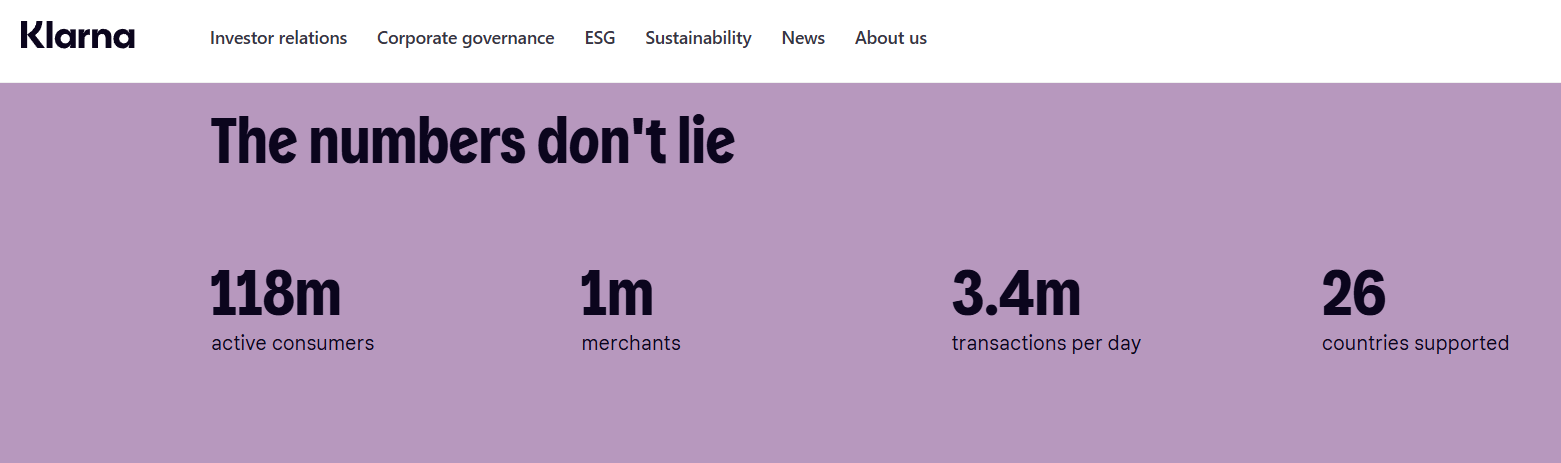
Klarna Global Usage Statistics
Klarna Bank AB is a Swedish fintech company founded in 2005 by Sebastian Siemiatkowski, Victor Jacobsson, and Niklas Adalberth. The company is headquartered in Stockholm, Sweden.
Klarna holds a full banking license granted in 2017. As a result, it operates under Swedish financial regulation. The platform is available in 26 countries. U.S. shoppers can access it through the Klarna app, the website, a browser extension, and directly at participating merchant checkout pages.
The company has 118 million active consumers globally and one million merchant partners. It processes 3.4 million transactions per day.
Klarna earns revenue from merchant fees. When a consumer uses Klarna at checkout, the merchant pays a processing fee. Therefore, the company does not rely primarily on consumer interest charges.
Klarna offers four consumer-facing payment products. These are Pay in 4, Pay in 30 Days, Pay Over Time, and Pay Now. It also offers a Klarna card, a balance account, and cashback rewards through the app. Additionally, the Klarna Plus membership costs $7.99 per month and waives service fees on non-partner purchases.
The company’s target audience includes U.S. consumers who want to split purchases into smaller payments. Klarna serves both budget-conscious shoppers and those looking for flexible payment options at major retailers.
Klarna key services and programs
Klarna is not one product. Instead, it is four different payment structures. The plan available at checkout depends on the merchant and the purchase amount.
Pay in 4
- The purchase is split into four equal payments every two weeks
- The first payment is due at checkout
- Zero interest applies if all four payments are made on time within eight weeks
- A late fee of up to $7 applies if a payment is 10 or more days overdue
- Late fees never exceed 25 percent of the purchase amount
- A service fee of up to $3 applies when using a one-time card at a non-Klarna partner retailer
- Klarna Plus members do not pay the service fee
- A soft credit check is performed at each application, with no score impact
Pay in 30 Days
- The shopper pays the full purchase price within 30 days of the order
- Nothing is due at checkout
- Zero interest applies
- A late fee applies if the balance is not paid within 30 days, and the amount varies by order
- Shoppers should check Klarna’s current terms before use
- A soft credit check is performed with no score impact
Pay Over Time
- The shopper repays over six to 24 months in fixed monthly installments
- Interest may apply depending on creditworthiness and merchant terms
- Zero interest is available on select offers
- A hard credit check is required and it affects the credit score
- This is a longer-term financing product subject to full credit review
Pay Now
- The shopper pays the full purchase price immediately at checkout
- No fees and no interest apply
- Cashback rewards are available in the Klarna app when purchases are made through a participating merchant
How Klarna works step by step
- Download the Klarna app or select Klarna at checkout on a participating merchant’s website
- Create a Klarna account with a name, email, phone number, and payment method such as a debit card, credit card or linked bank account
- Select a preferred payment plan based on what the merchant offers
- Klarna conducts a soft credit check for most plans or a hard check for Pay Over Time
- For Pay in 4, the first payment is charged at checkout, and the remaining three payments are auto-debited every two weeks
- For Pay in 30, no charge applies at checkout, and the full amount is due within 30 days
- All payments, due dates, and purchase history are managed in the Klarna app
- For purchases at non-partner retailers, Klarna generates a one-time virtual card accepted anywhere Visa is accepted
The one-time card feature in step eight allows Klarna to be used at any Visa-accepting retailer. However, this triggers a service fee unless the shopper has Klarna Plus.
Does Klarna require a credit check?
Pay in 4, Pay in 30, and Pay Now all use a soft credit check. This does not affect the credit score. It is also not visible to other lenders.
Pay Over Time requires a hard credit check. This temporarily affects the credit score. It is visible to other lenders.
Approval for any Klarna purchase is a per-transaction decision. As a result, being approved for one purchase does not guarantee approval for the next. Klarna considers credit score, credit history, outstanding debt, income, and spending patterns in its approval decisions.
Klarna pricing and fees
Klarna does not charge interest on its most popular plans. Pay in 4, Pay in 30, and Pay Now are all interest-free products. The costs come from two sources. These are late fees and service fees.
Late fees on Pay in 4 reach up to $7 per missed payment after a 10-day grace period. These fees are capped at 25 percent of the original purchase amount. Pay in 30 also charges a late fee if the full balance is not paid within 30 days.
A service fee of up to $3 applies when shoppers use a Klarna one-time virtual card at a non-partner retailer. This fee is waived for Klarna Plus members who pay $7.99 per month.
Pay Over Time is the only plan that may charge interest. Rates depend on creditworthiness and merchant terms. However, some Pay Over Time offers include zero percent interest for a promotional period.
Compared to traditional credit card interest rates, which average above 20 percent APR in 2026, Klarna’s Pay in 4 and Pay in 30 plans cost nothing when payments are made on time. The risk is not in the interest. Rather, it is in the accumulation of late fees across multiple active plans.
Klarna’s fee structure is more transparent than many traditional lenders. Still, shoppers should read the full terms for each plan before committing. Fees and policies can change, and the terms may vary by merchant and purchase amount.
Klarna and your credit score: What changed
Klarna began reporting U.S. customer activity to TransUnion in late 2024. Full integration continued through 2025. This is a significant change from prior years, when most buy now pay later activity did not appear on credit reports.
The practical impact is straightforward. On-time payments on Klarna plans can now help build credit history. Conversely, missed or late payments can now damage credit scores.
U.S. senators sent a formal letter to Klarna in November 2025. They requested data on how buy now pay later products affect consumers amid the CFPB rollback of oversight. This reflects ongoing regulatory attention to the credit reporting side of buy now pay later services.
Klarna states on its website that it does report to credit bureaus. However, this area has been evolving rapidly. As of August 2025, Klarna and Afterpay had opted not to send all buy now pay later data to credit bureaus, per reporting from PaymentsJournal. For this reason, shoppers should verify the current policy on klarna.com before making decisions based on credit-building.
Klarna customer reviews and what shoppers report across every platform
Moving beyond the general customer feedback, let’s take a closer look at Klarna’s Trustpilot reviews.
Trustpilot reviews

Klarna Trustpilot profile
Klarna has a 4.4 rating with more than 515,000 Trustpilot reviews. This is significantly larger than any other lender or service reviewed in this series.
Positive reviews describe a seamless application and checkout experience. Shoppers appreciate payment splitting for managing large purchases. In addition, cashback rewards are cited as a genuine benefit. Customer service is described as responsive in straightforward cases.
Negative reviews concentrate on three areas. These are return and refund processing failures, dispute resolution delays, and autopay failures. The company responds to the majority of Trustpilot reviews. However, responses to negative reviews often redirect shoppers to customer service channels rather than resolving the issue publicly.
Better Business Bureau (BBB) reviews

Klarna BBB Profile
Klarna holds a BBB rating that shoppers should verify at BBB.org before relying on this information.
BBB complaints document two specific patterns. The first is identity theft and fraudulent account opening. Multiple complaints describe accounts opened without authorization. As a result, Klarna’s dispute investigation is described as slow or unresolved for months.
The second pattern involves return credit application failures. Merchants issue refunds, but Klarna applies them to account balances rather than refunding the original payment method. Both patterns appear in documented 2025 and early 2026 BBB complaints.
ConsumerAffairs reviews
ConsumerAffairs reviews are predominantly negative. This is consistent with the platform’s self-selection of dissatisfied customers.
Three complaint themes appear across multiple 2025 reviews. The first involves dispute resolution failures where merchants sell defective or undelivered products. Klarna does not rule in the shopper’s favor despite documentation. The second is return processing, where Klarna continues charging after a return is accepted. The third involves a 2024 system change requiring linked bank accounts that blocked some existing users from making timely payments.
The company responds to some ConsumerAffairs reviews. However, the resolution rate is unclear.
Reddit reviews
Reddit discussions about Klarna in r/personalfinance and r/frugal reflect mixed sentiment. Users speak positively about the basic Pay in 4 use on planned purchases. On the other hand, they express caution for anyone with multiple active plans at the same time.
LendingTree data cited by multiple Reddit discussions shows that 41 percent of buy now pay later users report being late on a payment at least once. This figure is not specific to Klarna but reflects the broader buy now, pay later pattern.
The three Klarna complaint patterns worth understanding before signing up
- Returns and refunds: Refunds are sometimes applied as a Klarna credit instead of returned cash. Shoppers should contact Klarna to pause autopay immediately after making a return.
- Dispute resolution: Despite a three-week stated timeline, disputes for issues like non-receipt or defective items can remain unresolved for months, and Klarna continues collecting payments during this time.
- Autopay failures: Autopay can stop without notification, leading to unexpected accumulated late fees. While Klarna has waived fees for confirmed system errors, shoppers must proactively contact customer service to resolve these issues.
Is Klarna legit?
Yes. Klarna is a legitimate, licensed bank founded in 2005. It operates with regulatory oversight in Sweden and under U.S. consumer protection laws including Truth in Lending Act requirements for buy now pay later products.
It’s 118 million active consumers and partnerships with Nike, Sephora, IKEA, and Airbnb are not indicators of a fraudulent operation.
The documented complaint patterns around refunds, disputes, and autopay failures are real operational weaknesses. They are not evidence of fraud. However, they represent meaningful risks for shoppers who use Klarna for large purchases or multiple plans at the same time.
The credit reporting change in 2024 to 2025 increases the stakes for missed payments compared to prior years. As a result, Klarna is no longer a credit-invisible transaction for most U.S. users.
Klarna outcomes and success rate
Klarna does not disclose a formal approval rate. Approval is per transaction, not per account, and depends on the shopper’s credit profile and spending patterns for each purchase.
What is documented across public sources gives a practical picture of how Klarna performs for users.
- Klarna processes 3.4 million transactions per day globally, reflecting consistent consumer adoption
- Over 515,000 Trustpilot reviews indicate broad usage, with a majority of positive experiences for routine purchases
- LendingTree data shows that 41 percent of buy now pay later users report being late on a payment at least once, though this figure is not specific to Klarna
- The free payment rescheduling feature on Pay in 4 allows shoppers to extend a due date once per order at no cost, reducing the likelihood of a late fee
- Shoppers who use Klarna exclusively for planned purchases at partner retailers with no expected returns report the most consistent positive outcomes
Results with Klarna depend heavily on how the service is used. The product performs well for its intended purpose. Conversely, it creates friction when used for purchases that involve returns, disputes, or multiple simultaneous plans.
Debt resolution timelines do not apply to Klarna in the same way they apply to debt settlement companies. However, shoppers who fall behind on multiple Klarna plans may need several months to clear outstanding balances and late fees.
Klarna pros and cons
Here’s a quick look at the main Klarna pros and cons:
Pros
- Pay in 4 and Pay in 30 are genuinely interest-free when payments are made on time
- Soft credit check for most plans means checking eligibility does not damage the credit score
- Free payment rescheduling on Pay in 4 allows a due date extension once per order at no cost
- A one-time virtual card allows Klarna use at any Visa-accepting retailer
- Cashback rewards of up to 10 percent are available on purchases through the Klarna app at participating merchants
- Over 515,000 Trustpilot reviews make it one of the most reviewed financial products available
- The free Klarna app includes purchase tracking, payment management and price drop alerts
- No hard credit check for Pay in 4 or Pay in 30
Cons
- A late fee of up to $7 on Pay in 4 applies after a 10-day grace period
- A service fee of up to $3 applies for non-partner retailer purchases without Klarna Plus
- No limit exists on how many simultaneous Klarna plans a shopper can have
- Autopay is mandatory and cannot be disabled for Pay in 4
- Return and refund processing is one of the most documented complaint categories
- Dispute resolution is described as slow and inconsistent in multiple complaints
- The credit reporting change in 2024 to 2025 means missed payments now affect credit scores
Klarna is best for and not recommended for
Klarna’s services cater to a specific demographic and financial situation, making it an excellent choice for some but unsuitable for others.
Best for
- Shoppers making planned purchases under $300 at Klarna partner retailers
- Consumers who want interest-free payment splitting with no credit score impact
- Buyers who do not expect to return the item and can cover all four payments on time
- Shoppers who want cashback rewards on purchases through the Klarna app
Not recommended for
- Impulse buyers or shoppers with tight budgets who may struggle to make four payments
- Consumers making large purchases above $500 where financing extends beyond eight weeks
- Shoppers who frequently return items, given the documented return processing gap
- Anyone using multiple simultaneous buy now pay later plans to cover expenses not supported by income
Klarna vs. Affirm, which is better for larger purchases?
Affirm charges no late fees and shows a transparent APR before purchase. It reports all loans to credit bureaus. As a result, this makes it better for larger planned purchases where the shopper wants full cost transparency and zero fee risk.
Klarna charges no interest on Pay in 4 and Pay in 30. It also offers cashback rewards, a one-time virtual Visa card for any retailer, and free rescheduling of payments. This makes it better for smaller, frequent purchases at partner retailers, where the shopper can reliably make all four payments.
For any purchase above $500 that extends beyond 8 weeks, Affirm’s no-fee structure and transparent APR make it the more predictable choice. In contrast, for purchases under $300 at Klarna partner retailers, Pay in 4 is a genuine zero-cost option.
Final verdict: Is Klarna worth it?
Klarna works as advertised for its core use case. It splits a manageable planned purchase into four interest-free payments at a partner retailer with no return expected.
The credit reporting change in 2024 to 2025 means missed payments now carry real credit score consequences. As a result, the stakes are higher than they were two years ago.
The three complaint patterns around returns, disputes, and autopay failures are real risks. These risks increase with purchase size and complexity.
For small planned purchases at partner merchants, Pay in 4 is a legitimate zero-cost option. For large purchases, frequent returns or tight budgets, shoppers should compare Affirm before choosing Klarna.
Frequently asked questions about Klarna
Does Klarna affect your credit score?
It depends on the plan. Pay in 4 and Pay in 30 use a soft credit check that does not affect the score. Pay Over Time uses a hard credit check that does. Klarna also began reporting payment activity to TransUnion in late 2024. As a result, missed payments can now damage credit scores.
What happens if a shopper returns something bought with Klarna?
The merchant processes the return and issues a refund. However, Klarna’s autopay may continue deducting payments until the refund is fully applied. Shoppers should contact Klarna immediately after starting a return to confirm the payment schedule is paused.
What is the Klarna service fee, and how can shoppers avoid it?
A service fee of up to $3 applies when using a Klarna one-time card at a non-partner retailer. Shoppers can avoid this fee by purchasing from Klarna partner merchants or by subscribing to Klarna Plus at $7.99 per month.
What is Klarna Plus, and is it worth it?
Klarna Plus costs $7.99 per month. It waives service fees on non-partner purchases and may include additional perks. It is worth considering for shoppers who regularly use Klarna at non-partner retailers. However, for shoppers who only use Klarna at partner stores, the membership may not provide enough value.
What is the difference between Klarna and Affirm?
Klarna offers interest-free Pay in 4 and cashback rewards. It is best for smaller purchases at partner retailers. In contrast, Affirm charges no late fees and shows a transparent APR before purchase. It is better for larger purchases where cost predictability matters most.
This article is for informational purposes only and does not constitute legal, financial, or tax advice. Always consult a licensed professional for advice tailored to your situation.


Sponsored Advertising Content:
Advertorial or Sponsorship User published Content does not represent the views of the Company or any individual associated with the Company, and we do not control this Content. In no event shall you represent or suggest, directly or indirectly, the Company's endorsement of user published Content.
The company does not vouch for the accuracy or credibility of any user published Content on our Website and does not take any responsibility or assume any liability for any actions you may take as a result of reading user published Content on our Website.
Through your use of the Website and Services, you may be exposed to Content that you may find offensive, objectionable, harmful, inaccurate, or deceptive.
By using our Website, you assume all associated risks.This Website contains hyperlinks to other websites controlled by third parties. These links are provided solely as a convenience to you and do not imply endorsement by the Company of, or any affiliation with, or endorsement by, the owner of the linked website.
Company is not responsible for the contents or use of any linked website, or any consequence of making the link.
This content is provided by New Start Advantage LLC through a licensed media partnership with Inquirer.net. Inquirer.net does not endorse or verify partner content. All information is for educational purposes only and does not constitute financial advice. Offers and terms may change without notice.


