
Advertorial or Sponsorship User published Content does not represent the views of the Company or any individual associated with the Company, and we do not control this Content. In no event shall you represent or suggest, directly or indirectly, the Company's endorsement of user published Content.
The company does not vouch for the accuracy or credibility of any user published Content on our Website and does not take any responsibility or assume any liability for any actions you may take as a result of reading user published Content on our Website.
Through your use of the Website and Services, you may be exposed to Content that you may find offensive, objectionable, harmful, inaccurate, or deceptive.
By using our Website, you assume all associated risks.This Website contains hyperlinks to other websites controlled by third parties. These links are provided solely as a convenience to you and do not imply endorsement by the Company of, or any affiliation with, or endorsement by, the owner of the linked website.
Company is not responsible for the contents or use of any linked website, or any consequence of making the link.
How much does link building cost?
How much does link building cost?
Link building does not have one price. Typical campaigns run from a few hundred dollars a month on the low end to several thousand, depending on your goals, competition and the quality of links you need.
While link building is a powerful long-term strategy, it’s just one piece of your search marketing puzzle. If you are still deciding how to balance your budget between earned and paid traffic, our guide on SEO vs. Google Ads may help clarify which strategy aligns best with your immediate goals.
Cheap packages are easy to find. They also tend to deliver spammy or irrelevant backlinks that do little for rankings and can violate Google’s spam policies. Knowing what you are paying for is the difference between a useful investment and wasted budget. This guide covers typical 2026 market ranges, what drives price, and how to budget for links that can help over the long term.
Key takeaways
- Link-building prices vary with link quality, industry, competition and who does the work.
- There is no fixed price that fits every website.
- Strong backlinks cost more because they are earned on reputable sites through outreach, content and relationships — not purchased in bulk.
- Low-cost, high-volume services often rely on spammy sites or automated tactics that can hurt search performance.
- Set a monthly budget around your goals, site size and competition. Do not optimize only for cost per link.
- Agencies, freelancers and in-house teams price the work differently. Each model has trade-offs.
- The useful campaigns pursue relevant, trusted links that can support rankings, traffic and long-term visibility.
- The cheapest option is rarely the best. Fewer high-quality links usually beat a pile of low-quality ones and carry less spam risk.
What is link building?
What is link building?
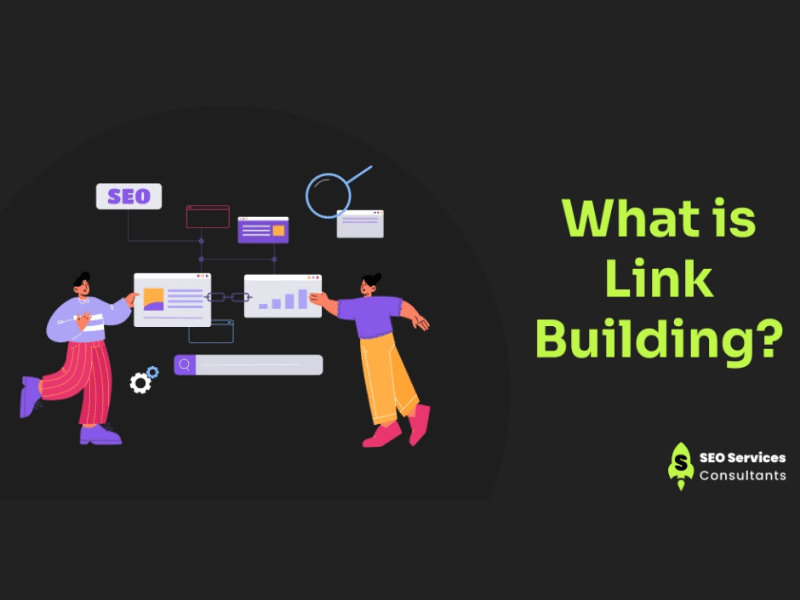
Link building is the process of getting other websites to link to your website. These links are known as backlinks and are like votes of confidence. If trusted sites link to your site, then search engines consider you to be more valuable and reliable.
Backlinks are still one of the most crucial ranking factors in SEO. While good content is critical, it also requires good backlinks to be competitive with good keywords.
There are many ways to build backlinks, including:
- Guest posting
- Digital PR
- Resource Page Outreach
- Broken Link Building
- HARO and journalist outreach
- Link-worthy guides and tools
- Creating original research and statistics
Not every backlink earned has the same value. A link obtained from a respected industry website is considered more valuable than several links from low-quality or unrelated websites. That is why quality matters far more than quantity.
How much does it cost?
How much does link building cost?
Link building cost depends on the service, the sites you are trying to earn links from, and how much research, content and outreach the work requires. Some businesses need only a few placements a month. Others fund a full search program.
There is no official U.S. average. In 2026, quality professional campaigns often land between $1,000 and $10,000 a month, with local or freelancer work starting lower and enterprise or digital PR programs running higher.
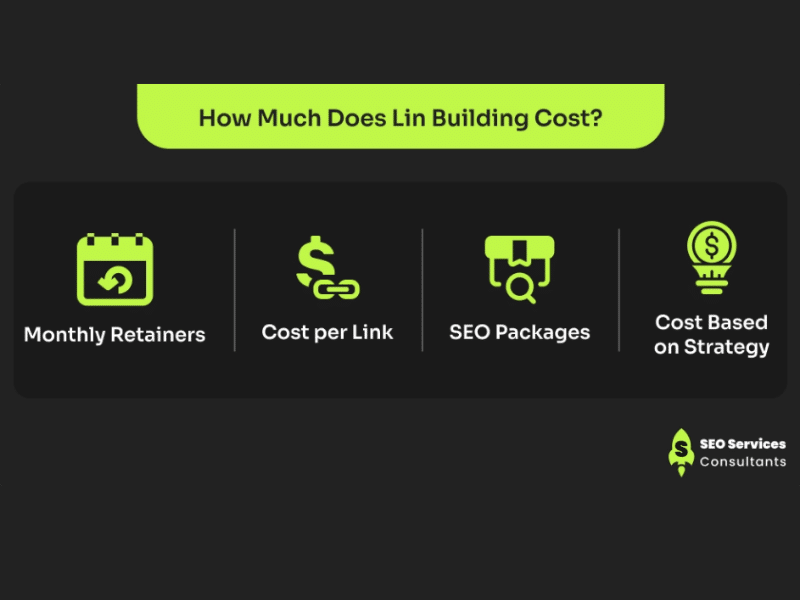
1. Monthly retainers
- Freelancer: $300 to $2,000 a month
- Small SEO agency: $1,000 to $5,000 a month
- Established SEO agency: $3,000 to $10,000+ a month
- Enterprise campaigns: $10,000 to $25,000+ a month
Monthly retainers fit teams that want steady output and compounding search gains rather than a one-off batch of links.
2. Cost per placement
These figures are what campaigns typically invest to earn one placement (research, content, outreach and publisher time). They are not a safe menu for buying ranking credit.
- Basic backlinks: $100 to $250
- Mid-quality editorial backlinks: $250 to $600
- High-authority editorial backlinks: $600 to $1,500+
- Premium digital PR placements: $1,500 or more
Industry surveys in 2025 and 2026 often put a quality editorial link around $350 to $600. Digital PR placements on well-known publishers cost more because the story, pitching and journalist relationships take more work.
The harder the site is to earn, the higher the cost. A mention on a respected industry publication is much harder than a link on a small blog that sells placements.
3. SEO packages
Some agencies fold link building into a broader monthly SEO retainer. Those programs may also cover keyword research, technical SEO, on-page work and content.
- Starter SEO: $500 to $1,500 a month. Fundamentals and light optimization. Meaningful link acquisition is uncommon at this price.
- Growth SEO: $1,500 to $5,000 a month. Content plus a modest, ongoing link-building program.
- Advanced or competitive SEO: $5,000+ a month. Full search program, including regular editorial or digital PR outreach.
Ahrefs’ pricing research found most U.S. and Canadian SEO providers charge more than $1,000 a month. Treat any “full SEO plus links” offer well below that as a quality flag, not a bargain.
4. Cost based on strategy
- Guest posts: $300 to $900 per placement. You are paying for the article as well as the outreach.
- Niche edits or link insertions: Often $100 to $400. Cheaper on average; quality varies widely.
- Broken-link building: Mostly labor. Time-intensive. Cash cost is low; hours are not.
- Resource-page outreach: Mostly labor. Works when you have a genuinely useful page to offer.
- Journalist queries (HARO, Connectively): Low cash, high labor. Hit rates are low. Wins can be strong when they land.
- Digital PR: $1,250+ per link, or $5,000 to $15,000 a month. Highest effort and usually the strongest placements.
How much should small businesses budget for link building?
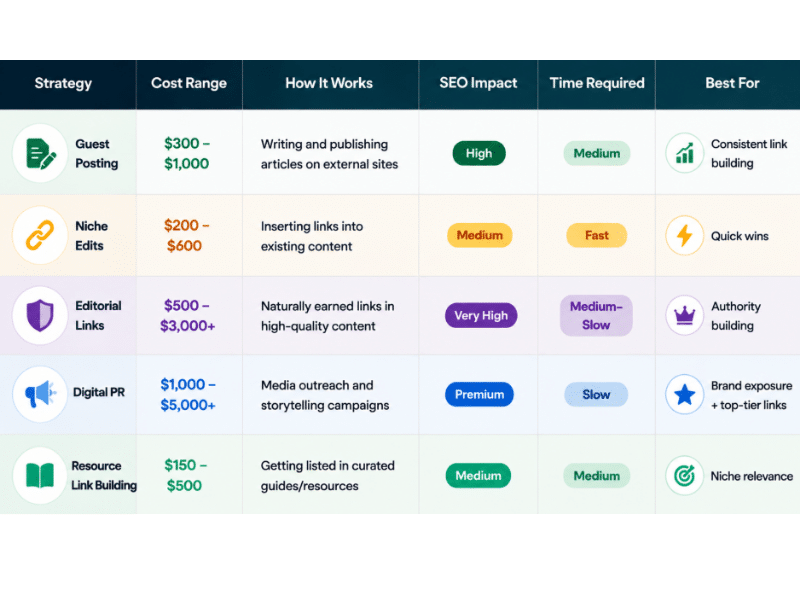
Strategy or methods that a link building campaign uses.
The strategy or methods that a link-building campaign uses also contribute to its cost. Each strategy covers the cost of the structure, SEO impact, and effort it requires.
There is no one-size-fits-all number. Industry, competition, goals and your current site strength all matter.
- Local small business: $500 to $1,500
- Growing small business: $1,500 to $3,000
- Competitive industries: $3,000 to $7,000+
- National or enterprise business: $7,000+
If you are new to search, build a solid site first — clear pages, useful content, technical hygiene — instead of chasing a large link count. A modest monthly spend can work when the outreach is relevant and the content is worth linking to.
Legal, finance, health care and software-as-a-service are harder. Authoritative sites in those fields get more pitches, so earning links takes more time and money.
Don’t ask, “What is the cheapest link-building service?” Ask, “What budget will buy links that can actually help us rank?”
What affects link building cost?
Several factors drive what you should expect to pay.
1. Website authority
Sites with strong reputations, real traffic and picky editors are harder to earn. They receive large volumes of pitches and publish only what meets their bar. That means more time, better content and stronger outreach — and a higher cost.
Third-party scores such as Moz Domain Authority or Ahrefs Domain Rating can help you compare sites. They are not Google rankings.
2. Industry competition
Some fields fight harder for the same keywords, including:
- Legal
- Health care
- Insurance
- Finance
- Software as a service
- Cybersecurity
Those industries usually need more high-quality links. A local landscaping company does not face the same link gap as a national personal injury firm.
3. Content creation
Many campaigns include writing: guest posts, research articles, infographics or original data. Better content costs more because it needs research, drafting, editing and optimization. It also tends to earn more links and keep its value after publication.
4. Outreach effort
Earned links are labor. A typical workflow includes:
- Finding relevant websites
- Researching editors
- Writing personalized emails
- Following up several times
- Negotiating placements
- Managing relationships
That work is slow, especially when the goal is a natural editorial link rather than a paid ranking link. More personal outreach usually means a higher success rate and a higher fee.
5. Link quality
Not every backlink costs the same. Higher-value links usually are:
- Relevant to your industry
- From sites with a real audience
- Supported by organic traffic, not just a metric score
- Placed editorially, in context
- Paired with natural anchor text
Low-cost backlinks often come from sites built to sell links. Those sites typically have thin content, little traffic and weak reputations. They are cheaper. They rarely help rankings for long.
Cheap link building vs high-quality link building
The lowest price is tempting. It is rarely the better investment. Link quality decides whether the spend helps.
Low-cost services often lean on automated tools, private blog networks, link farms or sites created only to sell backlinks. The links usually come from low-traffic, low-relevance pages. They can inflate a link count without improving rankings. In some cases they match Google’s definition of link spam.
High-quality link building aims to earn links from trusted, relevant sites through content and relationships. It takes longer and costs more. Those links are also the ones more likely to support rankings, referral traffic and long-term site trust.
Cheap link building
- Low upfront cost
- Automated or bulk methods
- Links from low-quality sites
- Little long-term search value
- Higher risk of Google treating the links as spam
High-quality link building
- Higher investment
- Manual outreach and relationships
- Links from trusted, relevant sites
- Stronger long-term search value
- Aligned with Google’s link-spam rules
If the goal is durable search growth, a handful of relevant, authoritative links will usually outperform dozens of cheap ones.
Is link building worth the cost?
For most businesses, yes — when the work stays inside Google’s rules and the links are relevant.
Earned backlinks can support keyword rankings, organic traffic, brand visibility and referral visits from sites your buyers already trust. Unlike paid ads, a good editorial link can keep helping for years.
A solid campaign can support:
- Better keyword rankings
- More organic traffic
- Stronger brand visibility
- Greater site trust over time
- Longer-lasting search growth
- Referral traffic from relevant sites
Link building is still only one part of search. It works best next to useful content, technical SEO and on-page work — not instead of them.
Final words
Link-building services can cost a few hundred dollars or several thousand dollars a month. The spread comes from link quality, competition and the labor behind each placement.
A low-cost service is more likely to deliver low-quality links that do not help, and may create spam risk. Paying for fewer, better placements is usually the stronger bet.
When you compare vendors, look past the sticker price. Ask what sites they can realistically earn, how they do outreach, and whether the work would still look legitimate if Google reviewed it. Done that way, link building is an investment that can keep paying off.
Frequently asked questions
What is the average cost of link building?
Many businesses budget $1,000 to $5,000 a month. Local or early-stage programs can start lower. Quality-focused and competitive campaigns often run $3,000 to $10,000. Large companies in hard industries may spend more than $10,000 a month. There is no single official average.
Why are high-quality backlinks expensive?
They take manual outreach, relationships, content and editors who can say no. That time and skill show up in the price.
Can small businesses afford link building?
Yes. Many start at $500 to $1,500 a month and raise spend if the links are relevant and results appear. Focus on quality, not volume.
How long does link building take to show results?
Many teams see movement in three to six months. The timeline depends on your site, competition and whether the links are actually earned on useful pages. It is not a guarantee.
Is it safe to buy backlinks?
Buying links that pass ranking credit violates Google’s spam policies. Paying for a review, sponsorship or advertorial is allowed when the link is marked sponsored or nofollow. If the pitch is “we will place a dofollow ranking link for $X,” treat that as a policy risk, not a bargain.
How many backlinks do I need to rank on Google?
There is no fixed number. It depends on the query, the competition and the quality of the links. A few relevant, trusted links can beat dozens of weak ones. Aim for a steady stream of natural, earned links rather than a target count.


