
Advertorial or Sponsorship User published Content does not represent the views of the Company or any individual associated with the Company, and we do not control this Content. In no event shall you represent or suggest, directly or indirectly, the Company's endorsement of user published Content.
The company does not vouch for the accuracy or credibility of any user published Content on our Website and does not take any responsibility or assume any liability for any actions you may take as a result of reading user published Content on our Website.
Through your use of the Website and Services, you may be exposed to Content that you may find offensive, objectionable, harmful, inaccurate, or deceptive.
By using our Website, you assume all associated risks.This Website contains hyperlinks to other websites controlled by third parties. These links are provided solely as a convenience to you and do not imply endorsement by the Company of, or any affiliation with, or endorsement by, the owner of the linked website.
Company is not responsible for the contents or use of any linked website, or any consequence of making the link.
Telemedicine app features patients actually use in 2026
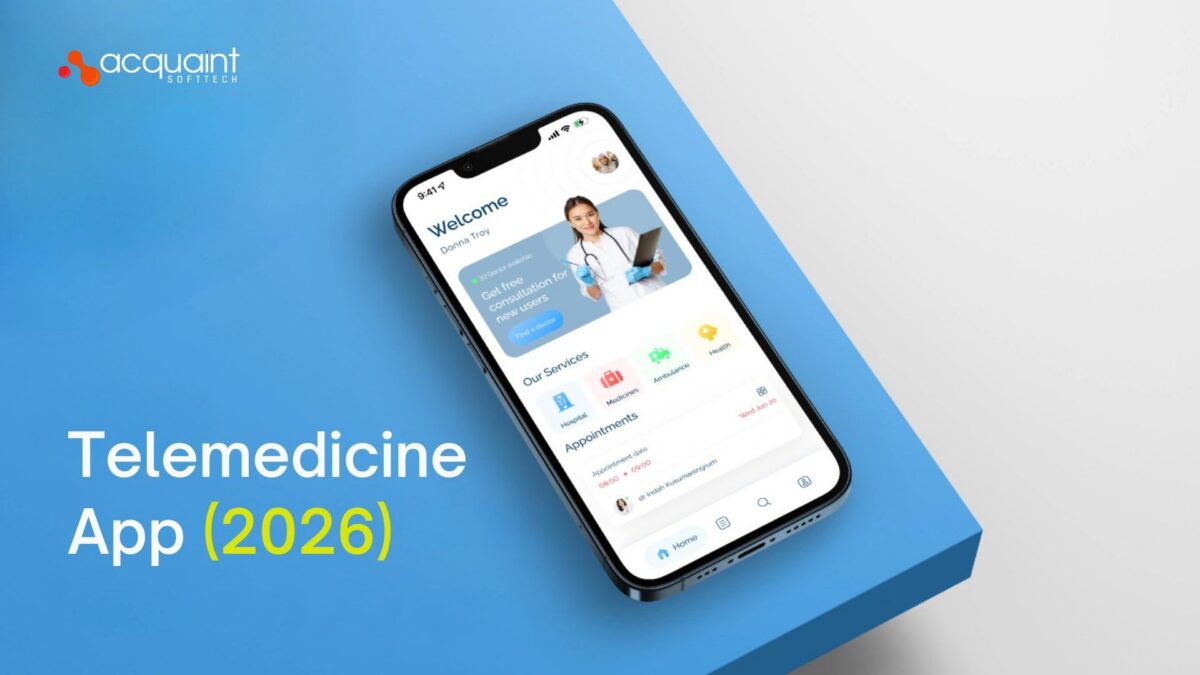
A patient-first telemedicine app in 2026 — one-tap video, quick-access services and appointment booking front and center. Image: Acquaint Softtech.
Why do some telemedicine apps keep patients engaged while others are abandoned after the first visit? As the Marketing Head at Acquaint Softtech, I have seen many telemedicine products prioritize impressive feature lists over real patient needs. The result is often low adoption, higher no-show rates and wasted development effort.
This article focuses on the features patients actually use and value, helping you build a telemedicine app that improves engagement, reduces no-shows and delivers measurable business results. Our healthcare app development team applies this evidence-first approach on every telemedicine build for clients across the USA, UK and Europe. This is a research piece inside the telemedicine cluster. For how the whole platform fits together, the parent guide How Telemedicine Apps Work covers the architecture these features run on.
1. Why do patients prefer virtual doctor visits in 2026?
Patients prefer virtual visits because they remove the three biggest barriers to care: travel, waiting-room time and scheduling delay. Telehealth usage has held near 76 percent for three consecutive years, and 83 percent of people who used telehealth in a given year had also used it within the prior 12 months (Rock Health, Consumer Adoption Survey). That repeat-usage rate is the clearest signal that virtual care has matured from novelty to habit.
Where preference is strongest
Preference for virtual care is strongest for prescription refills, followed by minor illness care and then mental health services (Rock Health). It is lower for complex chronic-condition management, where patients still value in-person contact. The pattern is clear: patients want virtual care for routine, predictable and conversation-based visits.
Telemedicine may account for 25 to 30 percent of US medical visits by 2026, driven largely by anticipated regulatory support (ScienceSoft forecast, reported by Patient Care Online, 2025). Designing for this volume means building for the routine visit first. Acquaint Softtech’s React Native developers build cross-platform patient apps so a single codebase serves both iOS and Android patient populations.
Understanding why patients choose virtual care also shapes the compliance posture, since patient trust depends on visible security. The HIPAA Compliance for Software Developers checklist covers the safeguards that protect that trust.
2. What are the must-have features patients actually use?
The must-have patient-facing features in 2026 are one-tap video joining, automated reminders, secure messaging, prescription and record access and in-app payment. These five are used in nearly every completed visit, while advanced features like wearable integration see far lower routine use. Build the first five; everything else is a phase-two decision.
Must-have features and why they matter:
- One-tap video join (no download) — used every visit. Join friction is the top cause of missed virtual visits.
- Automated appointment reminders — used every booking. Single biggest lever on no-show reduction.
- Secure messaging with the clinic — high use between visits. Handles the questions that do not need a full visit.
- Prescription and record access — high use post-visit. Patients expect to leave a visit with a prescription sent.
- In-app payment (copay, self-pay) — used every paid visit. Removing the separate billing step lifts completion.
- AI symptom checker and triage — moderate, pre-visit use. Growing consumer use for initial guidance.
The features that patients ignore are usually the ones built for the provider, not the patient: dense dashboards, configuration screens and anything requiring more than one tap to start a visit. Acquaint Softtech’s software product development practice scopes the patient MVP around these five proven features before adding differentiators. Organizations looking to scale development teams can also hire MEAN stack developers from Acquaint Softtech to accelerate the delivery of secure, user-friendly healthcare applications.
What patients expect from a health app now mirrors what they expect from banking or food-delivery apps: speed, clarity and one-tap actions. For how these features sit inside a full build budget, the Healthcare App Development Cost guide breaks down cost by feature.
3. What telemedicine features reduce appointment no-shows?
Frictionless self-scheduling combined with automated reminders is the single most effective no-show reducer. Research consistently shows that automated reminders alone cut missed appointments meaningfully, and pairing them with easy self-scheduling compounds the effect.
Healthcare providers looking to build these capabilities into their platforms often choose to hire MERN Stack developers to create scalable patient scheduling, reminder automation and engagement solutions.
The features that move the no-show number
- Self-scheduling with real-time availability, so patients book in seconds without a phone call.
- Automated multi-channel reminders (push, SMS, email) timed at booking, 24 hours before and one hour before.
- One-tap join with no download or login friction at the moment of the appointment.
- Easy reschedule rather than cancel, which keeps the patient in the funnel instead of losing them.
- Productive waiting-room screens (intake forms) that reduce perceived wait time and abandonment.
No-shows are not a patient-discipline problem; they are a friction problem. Every tap between intent and visit is a chance to lose the patient. Acquaint Softtech’s React Native developers build the join flow to a strict one-tap standard, because that single screen drives the no-show number more than any other.
Reminders and scheduling are also where automation pays back fastest in operational cost. For teams scaling a build to handle this orchestration, the dedicated software development teams model provides the cross-functional capacity, and the How Telemedicine Apps Work guide shows where scheduling sits in the system.
4. Do patients prefer video or chat in telemedicine?
Patients prefer video for the consultation itself and chat for everything around it. Video remains the format of choice for the actual diagnostic conversation, while secure messaging dominates for follow-up questions, prescription queries and quick clarifications that do not justify a full appointment.
For healthcare businesses looking to build such flexible telemedicine solutions, partnering with experienced teams and choosing to hire Laravel developers can help create secure, scalable and patient-friendly platforms. The winning apps offer both and let the patient choose.
When each format wins:
- Initial diagnostic consultation → Video: visual cues and rapport matter for diagnosis.
- Follow-up question after a visit → Chat: faster, asynchronous, no appointment needed.
- Prescription refill request → Chat or async: routine and text-based by nature.
- Mental health session → Video: therapeutic relationship depends on presence.
- Pre-visit symptom triage → AI chatbot: growing adoption for initial assessment.
The mistake is forcing every interaction into a video call. Patients abandon apps that make them schedule a video visit for a question that a two-line message could answer. Acquaint Softtech’s software product development team designs the patient flow so video and chat are complementary, not competing.
5. What features increase patient engagement in telehealth?
Engagement rises when the app removes effort: instant booking, one-tap video, in-app prescriptions, automated reminders and personalized communication. Patients who stay connected through these tools return more often, follow treatment plans better and refer others.
AI-powered features developed by experienced teams, including those who hire Python developers, add further value through intelligent automation and symptom analysis. Consumer appetite for AI in care is rising fast: 32 percent of consumers reported using AI chatbots for health information in 2025, up from 16 percent the year before (Rock Health, 2025 Consumer Adoption Survey).
The engagement multipliers
- AI symptom triage that gives an instant next step before the visit, cutting wait-time anxiety.
- Wearable integration that pulls vitals into the visit, making the consultation feel personalized rather than generic.
- Personalized reminders and follow-up nudges that keep patients in their care plan between visits.
- Visible health records, lab results and prescriptions that give patients ownership of their own data.
Expert Insight | Acquaint Softtech
“Engagement is not a feature you add; it is friction you remove. Every time we cut a tap from the patient journey, return-visit rates went up. The flashiest feature in the app rarely moves the needle. The join button always does.”
— Zubair Pateljiwala, Senior Mobile App Developer, Acquaint Softtech | Patient-facing telehealth and mobile health app delivery, USA, UK and Europe
AI is the fastest-growing engagement lever in 2026, with the AI-in-telehealth and telemedicine market projected to reach about $27 billion by 2030 at a 36.4 percent CAGR (MarketsandMarkets). Acquaint Softtech’s AI and ML development services build symptom triage and personalization features that lift engagement without crossing into regulated diagnostic territory.
6. The patient-use feature tiering framework
Use this framework to decide what goes in version one. It sorts every telemedicine feature by how often patients actually use it, not by how impressive it looks. This is the model Acquaint Softtech applies when scoping a patient MVP.
The Acquaint Softtech Patient-Use Feature Tiering Framework
- Tier 1 — Used in every visit (build first): one-tap video join, automated reminders, self-scheduling, in-app payment, prescription and record access. Skip any of these and patients abandon the app.
- Tier 2 — Used between visits (build within 3 months): secure messaging, AI symptom triage, follow-up nudges, easy reschedule. These drive retention and lower no-shows.
- Tier 3 — Used by a subset (phase-two differentiators): wearable integration, multi-language support, family or caregiver access, loyalty and feedback tools. Valuable for specific populations, not for launch.
- Tier 4 — Looks impressive, rarely used (defer or cut): dense analytics dashboards for patients, gamification without clinical purpose, video features that add taps. Build only with evidence of demand.
The discipline this framework enforces is simple: a feature earns a place in version one only if patient-use data supports it. Acquaint Softtech’s discovery workshop services run this tiering exercise with founders before any development is scoped, and the virtual CTO services provide the product judgment to defend a lean version-one scope against feature creep. Tiering also keeps the budget honest, because every deferred feature is money not spent before product-market fit.
7. Frequently asked questions
What are the essential features of a telemedicine app?
A telemedicine app needs video consultations, appointment scheduling, automated reminders, secure messaging, prescription access and in-app payments. These features support most patient interactions and should be prioritized in the MVP.
Which telemedicine features improve patient engagement?
Instant booking, one-tap video calls, prescription management, automated reminders and AI symptom assessment improve patient engagement by making healthcare access faster and more convenient.
Do patients prefer video calls or chat in telemedicine?
Patients prefer video calls for consultations and diagnoses, while chat is preferred for follow-ups, prescription questions and routine communication. The best telemedicine apps provide both options.
What reduces no-shows in telemedicine appointments?
Automated reminders, self-scheduling, one-tap appointment joining and easy rescheduling significantly reduce telemedicine no-shows by removing friction from the patient journey.
How much does it cost to build a telemedicine app?
Estimated MVP cost by region:
- USA: $50,000–$90,000
- UK: £40,000–£72,000
- Europe: €46,000–€83,000
Note: These are Acquaint Softtech estimates. Development costs can be lower when working with experienced offshore healthcare software development teams.


