
Advertorial or Sponsorship User published Content does not represent the views of the Company or any individual associated with the Company, and we do not control this Content. In no event shall you represent or suggest, directly or indirectly, the Company's endorsement of user published Content.
The company does not vouch for the accuracy or credibility of any user published Content on our Website and does not take any responsibility or assume any liability for any actions you may take as a result of reading user published Content on our Website.
Through your use of the Website and Services, you may be exposed to Content that you may find offensive, objectionable, harmful, inaccurate, or deceptive.
By using our Website, you assume all associated risks.This Website contains hyperlinks to other websites controlled by third parties. These links are provided solely as a convenience to you and do not imply endorsement by the Company of, or any affiliation with, or endorsement by, the owner of the linked website.
Company is not responsible for the contents or use of any linked website, or any consequence of making the link.
Healthray laboratory information management system for efficient healthcare operations
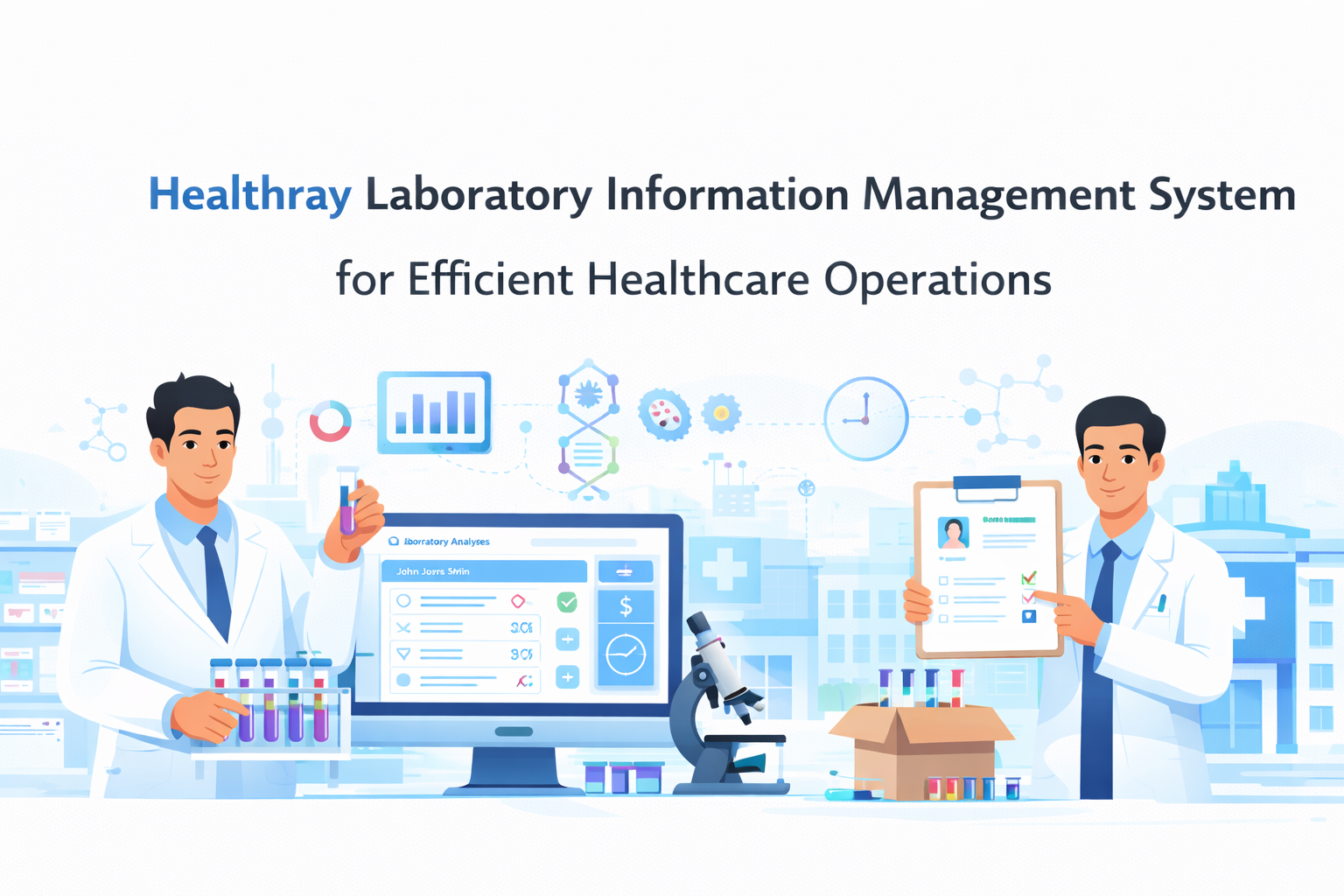
Healthray Laboratory Information Management System (LIMS)
A modern Laboratory Information Management System simplifies the process of diagnostics by automating the process of tracking samples, test procedures, and report delivery in all healthcare activities. It is accuracy-based and fast, which reduces the number of mistakes that are made by humans, enhances the turnaround time, and improves data compatibility. Informed clinical decisions are provided with the help of integrated analytics, and compliance and patient trust are enhanced with the help of secure data handling. The scalable architecture and easy interfaces help healthcare facilities to handle the increasing lab volumes effectively. The healthcare-oriented innovation empowers the laboratories with the ability to attain operational excellence, enhanced productivity, and flow of coordination.
Challenges faced by modern healthcare laboratories
Contemporary medical laboratories encounter various issues since the number of diagnostic requirements keeps increasing in all hospital settings. Massive volumes of tests, manual data entry, and inefficient workflows usually result in delays, errors, and inefficiency. Without centralized control, managing samples between collection and reporting is a complicated task that exposes the chances of mislabeling and loss of data. Compliance with regulations and data protection further increases this pressure, given that the day-to-day work of laboratories involves working with sensitive patient data.
The second significant barrier is the interoperability of the laboratory systems with other technology platforms applied in hospitals. Unconnected systems decrease the ability to share real-time information, slow down the clinical decision-making process, and decrease the quality of care in general. Moreover, there is a shortage of workforce and increased cost of operations, which complicate retention of accuracy in laboratories within the expectations of turnaround time.
It is here that a lab management information system is very necessary. In order to address these barriers, it is important to understand what LIMS are in the healthcare setting and how they can be used to automate the workflow in a laboratory, enhance traceability, and remove inaccuracies and errors in the data. Nevertheless, the choice and adoption of the appropriate system is still a problem, which needs strategic planning, training, and coordination with hospital objectives.
Role of laboratory information management system in operational efficiency
Laboratory Information Management System has become an important aspect of enhancing the efficiency of operations in contemporary healthcare laboratories. It removes paperwork and errors, and speeds up the process of diagnosing, as most of the processes are digitized and automated. Each step in the process of generating a report is made lean in that it is precise and consumes less time in order to register a sample to generate the report.
The software, Advanced Pathology Lab Software empowers the laboratories to handle high volumes of tests without the reduction of quality. An effective lab management information system also centralizes information, thereby providing real-time tracking of samples, status of tests, and test results. Such visibility increases the coordination of lab personnel, clinicians, and departments in the hospital, making them more productive.
The current LIMS Software is also capable of connecting with hospital systems, billing systems, and electronic health records to form a connected ecosystem. Automation minimizes redundant operations, streamlines the use of resources, and assists laboratories in regulating the operational expenses as well as satisfying compliance requirements.
Scalable architecture and secure data management solutions in line with innovation at Healthray facilitate the ability of laboratories to scale to meet increasing requirements. A Laboratory Information Management System can be the foundation of efficient, technology-intensive healthcare operations by enhancing the efficiency of the working process, accuracy of the information, and speed of decision-making.
Key features of an advanced laboratory information management system
A developed Laboratory Information Management System is developed to streamline the laboratory processes by automating and integrating all key processes. It starts with the smooth Order Booking, whereby proper requests for tests will be taken, and errors related to manual work will be minimized. The barcode-based tracking and efficient Sample Collection enhance the traceability between Accession and Processing to reduce delays and misidentification throughout the Pathology workflows.
The Automated Report creation facilitates quicker production of results in standardized formats, whereas a systematic Approval process helps in quality control of the results prior to their publication to the clinicians or patients. The connection with the Radiology Information System enables the laboratories to contribute to multidisciplinary diagnostics and provide all information in one platform.
Strong Data security is an essential aspect that safeguards confidential patient information by using role-based access, audit trail, and standards-compliant security measures. State-of-the-art analytics and dashboarding assist in performance tracking and operational betterment choices. In-house Laboratory Billing Software simplifies invoicing, insurance processing, and tracking of revenues to achieve financial precision.
The LIMS System at the Healthray Company is based on scalability and interoperability, enabling laboratories to handle increasing workloads effectively without compromising on accuracy, compliance, and quality diagnostic services.
Streamlining sample collection and tracking
Automation of sample collection and tracking is essential to provide correct and timely diagnostics in contemporary Healthcare laboratories. Clinical outcomes are usually influenced by manual processes, mislabeling of samples, delays, and decreased traceability. It is at this point that it is important to learn how the LIMS can be utilized in healthcare to enhance operational efficiency and reliability.
A powerful lab management information system will automate the whole process of the sample lifecycle, from registration to final reporting. By having workflows with barcodes, the laboratories will be able to be certain of the identification during the collection, transportation, and testing. Another way to increase visibility is by using Advanced Pathology Lab Software, which will give a real-time update on the status to decrease the need to rely on manual follow-ups and paperwork.
A Lab Management System consolidates information and allows laboratory staff and clinicians to retrieve the correct information about the samples in real-time. This enhances coordination, reduces turnaround times, and increases the level of trust among patients. Compliance is also encouraged through automation by having audit trails and standardized procedures.
Through Healthray innovation, the laboratories will be able to embrace scalable solutions that can enable them to handle the increasing number of tests without jeopardizing the accuracy of their tests. Automated tracking of the samples will make the sample tracking process more consistent, error-free, and increase the overall quality of healthcare diagnostics.
Automation of lab workflows and test processing
The process of lab work and test processing is being automated, which is changing the way a modern laboratory provides speedy and accurate diagnostics. A strong laboratory information management system will change the tedious, manual laborious tasks to smart automation processes where there is a unanimity in all levels of the laboratory operations. Automated workflow minimizes human error and enhances efficiency in terms of test ordering, results validation, and general workflow.
The aspect of LIMS in healthcare is particularly critical because the number of tests that laboratories have to complete and the amount of complicated diagnostic data grow. Automated sample routing, test allocation based on rules, and real-time monitoring of the status of tests assist the laboratories in optimizing the usage of resources and will reduce the turnaround time. Such a degree of automation enables laboratory specialists to work more on quality analysis than on administrative work routines.
Inbuilt quality checks and warnings make sure that tests are performed according to the specified procedures, enhancing reliability and compliance. The automation is also used to facilitate a smooth flow of data with clinical systems, facilitating quicker decision-making and better patient care. Laboratories can achieve accuracy by cutting down delays and processing tests faster, thus being able to increase their capacity.
In general, automated processes on the basis of laboratory information management systems provide a systematic, productive, and reactive laboratory atmosphere, which enhances diagnostic results throughout the healthcare ecosystem.
Data security, compliance, and regulatory standards in healthcare
Information security, policy, and legislative requirements are essential foundations of contemporary healthcare functions, and this is particularly the case in diagnostic labs where patients provide confidential data. With the increasing volume of data, it is important that laboratories maintain the confidentiality, integrity, and accessibility of the medical records on top of regulatory compliance. An effective lab management information system is important in ensuring the safety of laboratory data by having controlled access, audit trails, and real-time monitoring.
Compliance with healthcare regulations is ensured with the help of the advanced LIMS Software through standardization of the workflow, documentation of all processes, and traceable records. Laboratories operating automated validation and logging will act responsibly in the process of audit and minimize the chances of non-compliance. Cyber threats and unauthorized access to data are also prevented with the help of encryption and role-based permissions.
Combination with a hospital management system improves the safe exchange of data between departments without any privacy loss. This integrated practice will help the clinicians to get the right information as well as stay in line with the regulations. Frequent updates of the system, data backup, and disaster recovery systems are also helpful in making the system resilient.
Through secure and compliant digital solutions, healthcare organizations will be able to preserve patient trust, minimize legal risks, and ensure no interruption to laboratory operations in a relatively regulated healthcare environment.
Conclusion
Innovative Laboratory Information Management System enhances effectiveness in all spheres of healthcare business by completing work processes, increasing accuracy, and maintaining the preservation of data security. Healthray Laboratory Information Management System assists the laboratories in handling increased labor workloads with ease by enhancing sample tracking, quicker reporting, and compliance with regulations. It allows healthcare providers to provide timely diagnostics and improved patient outcomes by minimizing the number of errors made manually and improving operational visibility. This is a technology-based solution that will provide scalable, reliable, and future-ready laboratory operations.


