
Canada cautions citizens about travel to the Philippines

Canada travel advisory: High caution for travel to PH over safety concerns
The Government of Canada has renewed its call for travelers to remain vigilant when visiting the Philippines, particularly as international travel picks up during the winter season.
In its updated travel advisory, Canada maintained its warning for travelers to the Philippines, stating, “Exercise a high degree of caution in the Philippines due to crime, terrorism and kidnapping.”
The reminder comes as the Philippines continues to be a popular destination for tourists seeking warmer weather during the colder months in North America.
‘Long-standing security challenges’ in Mindanao
While many areas of the Philippines remain open to tourism, the Canadian government drew a clear distinction between regions with elevated risks and those deemed relatively safer. The advisory is especially strict when it comes to parts of Mindanao, where they stated, “long-standing security challenges persist.”
Avoid all travel
For Western Mindanao, Canada advised travelers to completely stay away, issuing an “Avoid all travel” warning.
Provinces included under this classification are Basilan, Cotabato, Lanao del Sur, Lanao del Norte, Maguindanao, Misamis Occidental, Sarangani, South Cotabato, Sultan Kudarat, Sulu, Tawi-Tawi and several provinces in the Zamboanga Peninsula.
According to the advisory, these areas face “the serious threat of terrorism, kidnapping, high levels of crime and violent clashes between the security forces and rebel groups.”
Avoid non-essential travel
Meanwhile, Central and Eastern Mindanao were placed under an “Avoid non-essential travel” category. This applies to provinces such as Agusan del Norte, Agusan del Sur, Bukidnon, multiple Davao provinces outside Davao City, Misamis Oriental and parts of Surigao del Norte and Surigao del Sur. The government pointed to the ongoing risk of kidnapping and persistent criminal activity in these locations.
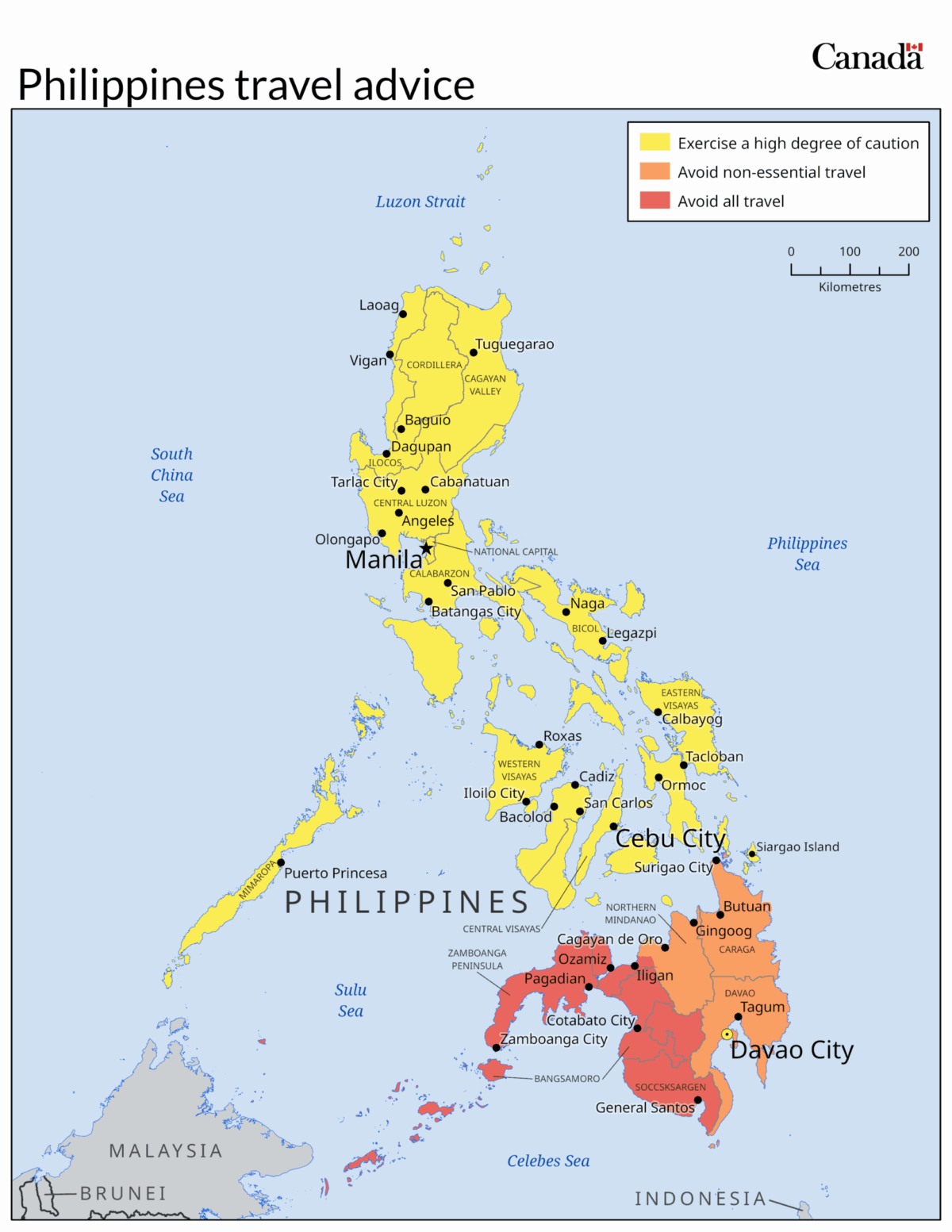
Photo from travel.gc.ca
The advisory further noted that extremist groups have been active in the southern Philippines for several years. Although authorities have succeeded in demobilizing some violent factions in recent years, Canada stressed that the threat has not been fully eliminated.
It highlighted that terrorist attacks and kidnappings remain a concern, particularly in the Bangsamoro Autonomous Region in Muslim Mindanao, the Zamboanga Peninsula and the Sulu archipelago.
Concluding the advisory, the Canadian government cautioned travelers about “the risk of being in the wrong place at the wrong time.”
They emphasize that their ability to provide consular assistance is limited if travelers become stranded in high-risk areas.


