
Advertorial or Sponsorship User published Content does not represent the views of the Company or any individual associated with the Company, and we do not control this Content. In no event shall you represent or suggest, directly or indirectly, the Company's endorsement of user published Content.
The company does not vouch for the accuracy or credibility of any user published Content on our Website and does not take any responsibility or assume any liability for any actions you may take as a result of reading user published Content on our Website.
Through your use of the Website and Services, you may be exposed to Content that you may find offensive, objectionable, harmful, inaccurate, or deceptive.
By using our Website, you assume all associated risks.This Website contains hyperlinks to other websites controlled by third parties. These links are provided solely as a convenience to you and do not imply endorsement by the Company of, or any affiliation with, or endorsement by, the owner of the linked website.
Company is not responsible for the contents or use of any linked website, or any consequence of making the link.
Generative AI vs. predictive AI: Which delivers more value for your business?
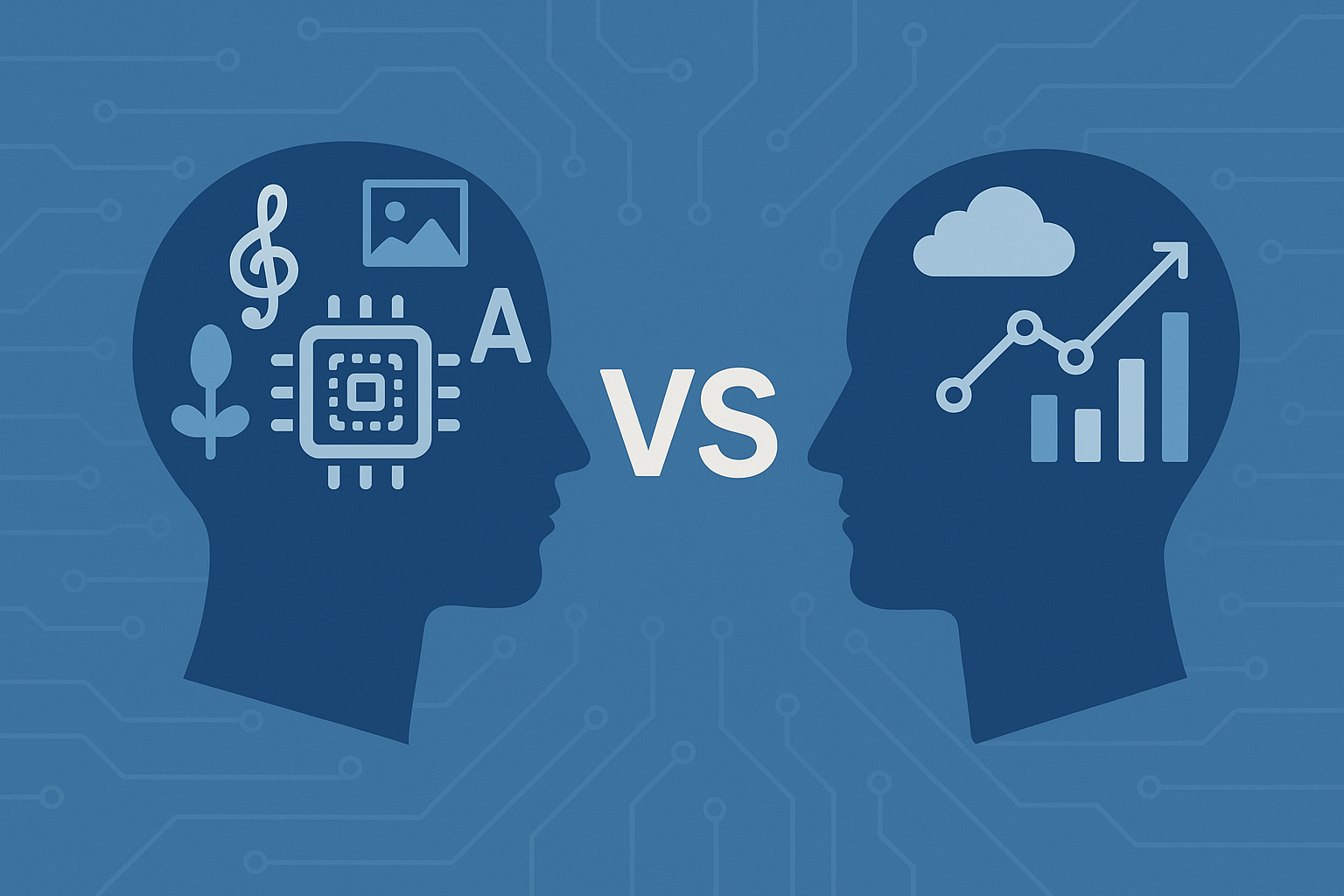
As businesses increasingly explore AI solutions, one of the key questions is: Which type of AI delivers more value, generative or predictive? Both bring unique strengths, and choosing (or combining) them wisely can determine how much real business value you get.
This article compares generative AI and predictive AI, highlights their respective business advantages and offers guidance on how to leverage them for maximum impact.
What is predictive AI?
Predictive AI (or predictive analytics) uses historical data and statistical/machine-learning models to forecast future outcomes or behaviors. Examples include:
- Predicting customer purchases or churn
- Detecting fraud in financial transactions
- Forecasting demand in supply chains
- Optimizing maintenance schedules in manufacturing
Because it directly supports decision-making, predictive AI is often used for process optimization, risk mitigation and operational efficiency.
What is generative AI?
Generative AI creates new content (text, images, code, designs, etc.) by learning patterns from large datasets. It includes tools like large language models, GANs, diffusion models, etc.
Key use cases:
- Content generation (marketing copy, documentation, creatives)
- Design, prototyping and ideation
- Automated code generation or augmentation
- Conversational agents and chatbots
Generative AI is often seen as more “creative” and flexible than predictive AI.
Predictive AI: More reliable and immediate ROI?
While generative AI is captivating, predictive AI often delivers more consistent and measurable business value for many established operations. Some arguments and examples:
- Higher bottom-line impact: According to a Forbes article, predictive AI frequently delivers higher returns than generative AI because it improves large-scale, mission-critical processes, marketing, logistics, fraud detection, etc.
- Autonomy and operational integration: Predictive AI can often run without a “human in the loop,” especially in scenarios like fraud scoring, pricing or demand forecasting. Generative AI, by contrast, usually requires human oversight.
- Cost and complexity: Predictive models are often lighter, less resource-intensive and easier to validate than large generative models, which tend to require vast computational power, data and infrastructure.
- Explainability and trust: Because predictive models are more narrowly focused and based on structured data, they are often more explainable. This is crucial for regulated industries and high-stakes decision environments.
Generative AI: Innovation, customer experience and scaling content
Generative AI, however, brings different kinds of value, often less immediate but potentially transformative:
- Creativity, personalization and scale: Generative AI can automate or assist content creation, design, product ideation, code generation, etc. This enables faster scaling of marketing, UX, product development and more.
- Brand differentiation and customer engagement: Custom-generated content, conversational agents, personalized experiences all drive better engagement, customer loyalty and brand perception.
- Innovation and new product models: Companies are exploring entirely new business models around generative AI (e.g., synthetic data, AI-powered design, etc.), which may generate longer-term growth opportunities.
Which delivers more value and when?
There’s no one-size-fits-all answer. The “better” AI type depends on your business goals, maturity, data infrastructure and risk profile. Here’s a rough guide:
| Scenario/Goal | Predictive AI is more valuable when… | Generative AI is more valuable when… |
| Optimizing operations, reducing cost, mitigating risk | You have structured data, stable workflows and need measurable ROI | — |
| Improving decision-making, forecasting, planning | Predictive models can directly feed decisions | — |
| Scaling content, enhancing UX, automating creative work | — | You need customized, human-like outputs (text, images, design) |
| Innovating, exploring new products or interfaces | — | You’re experimenting with new user experiences, prototypes or services |
| Early-stage AI adoption or high regulatory context | Predictive AI is safer, more explainable | Generative AI may pose higher risks or require oversight |
Challenges and risks
Both types of AI come with caveats:
- Generative AI hype vs. reality: Many generative AI projects haven’t delivered measurable value, often due to flawed integration with workflows.
- Risk, compliance, bias: Predictive AI also has issues (bias, misuse, etc.). Some firms report losses in early AI deployments due to compliance, output quality or governance gaps.
- Overemphasis on generative AI: Business leaders often chase “cool outputs” without ensuring they’re scalable, accurate or business-aligned.
How to get value: Use both, strategically
The best AI strategies don’t pick sides — they combine generative and predictive AI where each makes sense:
- Use predictive AI to power decision systems, operations, demand forecasting, risk models, etc.
- Use generative AI to automate creative tasks, design new offerings, improve user experiences or generate insights and prototypes.
- Use predictive AI to evaluate, test and monitor generative AI’s outputs (e.g., which generated content leads to better engagement or conversions).
- Start small, scale with data governance, human oversight and feedback loops to validate value.
Conclusion
- Predictive AI currently delivers more consistent value for enterprise operations, optimization, forecasting and decision support.
- Generative AI offers powerful capabilities for creativity, engagement and innovation — but its business impact depends heavily on integration, oversight and alignment.
- Smart strategy combines both, using predictive models for structure and reliability, and generative models for creativity and customer-facing innovation.
If you’re considering building generative AI solutions, you might want to explore professional services. For example, check out Sayone Technologies’ offering on Generative AI development and services for practical guidance on how to get started.
By understanding both paradigms and deploying them wisely, businesses can maximize AI value, not just in headlines, but in real results.


